now stand, because I have duties to others elsewhere,
and my heart is not here. What passed within
me has nothing to do with you. When the man whom
you call Usher of the Black Rod came to seek me by
order of the woman whom you call the Queen, the idea
struck me for a moment that I would refuse to come.
But it seemed to me that the hidden hand of God pressed
me to the spot, and I obeyed. I felt that I must
come amongst you. Why? Because of my rags
of yesterday. It is to raise my voice among those
who have eaten their fill that God mixed me up with
the famished. Oh, have pity! Of this fatal
world to which you believe yourselves to belong you
know nothing. Placed so high, you are out of it.
But I will tell you what it is. I have had experience
enough. I come from beneath the pressure of your
feet. I can tell you your weight. Oh, you
who are masters, do you know what you are? do you
see what you are doing? No. Oh, it is dreadful!
One night, one night of storm, a little deserted child,
an orphan alone in the immeasurable creation, I made
my entrance into that darkness which you call society.
The first thing that I saw was the law, under the
form of a gibbet; the second was riches, your riches,
under the form of a woman dead of cold and hunger;
the third, the future, under the form of a child left
to die; the fourth, goodness, truth, and justice,
under the figure of a vagabond, whose sole friend
and companion was a wolf.”
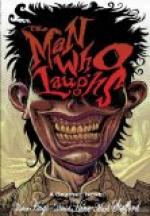
Just then Gwynplaine, stricken by a sudden emotion,
felt the sobs rising in his throat, causing him, most
unfortunately, to burst into an uncontrollable fit
of laughter.
The contagion was immediate. A cloud had hung
over the assembly. It might have broken into
terror; it broke into delight. Mad merriment
seized the whole House. Nothing pleases the great
chambers of sovereign man so much as buffoonery.
It is their revenge upon their graver moments.
The laughter of kings is like the laughter of the
gods. There is always a cruel point in it.
The lords set to play. Sneers gave sting to their
laughter. They clapped their hands around the
speaker, and insulted him. A volley of merry
exclamations assailed him like bright but wounding
hailstones.
“Bravo, Gwynplaine!”—“Bravo,
Laughing Man!”—“Bravo, Snout
of the Green Box!”—“Mask of
Tarrinzeau Field!”—“You are
going to give us a performance.”—“That’s
right; talk away!”—“There’s
a funny fellow!”—“How the beast
does laugh, to be sure!”—“Good-day,
pantaloon!”—“How d’ye
do, my lord clown!”—“Go on with
your speech!”—“That fellow
a peer of England?”—“Go on!”—“No,
no!”—“Yes, yes!”
The Lord Chancellor was much disturbed.
A deaf peer, James Butler, Duke of Ormond, placing
his hand to his ear like an ear trumpet, asked Charles
Beauclerk, Duke of St. Albans,—
“How has he voted?”
“Non-content.”
“By heavens!” said Ormond, “I can
understand it, with such a face as his.”

 Print
Print Word
Word PDF
PDF




