
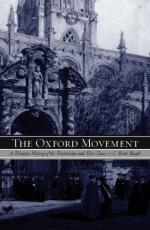
The Oxford Movement eBook

Richard William Church
This eBook from the Gutenberg Project consists of approximately 377 pages of information about The Oxford Movement.

The Oxford Movement eBook

Richard William Church
This eBook from the Gutenberg Project consists of approximately 377 pages of information about The Oxford Movement.
those who remained had much to think about, between grief at the breaking of old ties, and the loss of dear friends, and perplexities about their own position.  The anxiety, the sorrow at differing and parting, seem now almost extravagant and unintelligible.  There are those who sneer at the “distress” of that time.  There had not been the same suffering, the same estrangement, when Churchmen turned dissenters, like Bulteel and Baptist Noel.  But the movement had raised the whole scale of feeling about religious matters so high, the questions were felt to be so momentous, the stake and the issue so precious, the “Loss and Gain” so immense, that to differ on such subjects was the differing on the greatest things which men could differ about.  But in a time of distress, of which few analogous situations in our days can give the measure, the leaders stood firm.  Dr. Pusey, Mr. Keble, Mr. Marriott accepted, with unshaken faith in the cause of the English Church, the terrible separation.  They submitted to the blow—­submitted to the reproach of having been associates of those who had betrayed hopes and done so much mischief; submitted to the charge of inconsistency, insincerity, cowardice; but they did not flinch.  Their unshrinking attitude was a new point of departure for those who believed in the Catholic foundation of the English Church.

Among those deeply affected by these changes, there were many who had been absolutely uninfluenced by the strong Roman current.  They had recognised many good things in the Roman Church; they were fully alive to many shortcomings in the English Church; but the possibility of submission to the Roman claims had never been a question with them.  A typical example of such minds was Mr. Isaac Williams, a pupil of Mr. Keble, an intimate friend of Mr. Newman, a man of simple and saintly life, with heart and soul steeped in the ancient theology of undivided Christendom, and for that very reason untempted by the newer principles and fashions of Rome.  There were numbers who thought like him; but there were others also, who were forced in afresh upon themselves, and who had to ask themselves why they stayed, when a teacher, to whom they had looked up as they had to Mr. Newman, and into whose confidence they had been admitted, thought it his duty to go.  With some the ultimate, though delayed, decision was to follow him.  With others, the old and fair proejudicium against the claims of Rome, which had always asserted itself even against the stringent logic of Mr. Ward and the deep and subtle ideas of Mr. Newman, became, when closed with, and tested face to face in the light of fact and history, the settled conviction of life.  Some extracts from contemporary papers, real records of the private perplexities and troubles actually felt at the time, may illustrate what was passing in the minds of some whom knowledge and love of Mr. Newman failed to make his followers in his ultimate step.  The first extract belongs to some years before, but it is part of the same train of thinking.[124]


Copyrights
Project Gutenberg
The Oxford Movement from Project Gutenberg. Public domain.
