
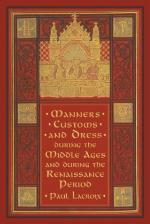
Manners, Custom and Dress During the Middle Ages and During the Renaissance Period eBook

Paul Lacroix
This eBook from the Gutenberg Project consists of approximately 551 pages of information about Manners, Custom and Dress During the Middle Ages and During the Renaissance Period.

Manners, Custom and Dress During the Middle Ages and During the Renaissance Period eBook

Paul Lacroix
This eBook from the Gutenberg Project consists of approximately 551 pages of information about Manners, Custom and Dress During the Middle Ages and During the Renaissance Period.
was but a pretext for intemperance and debauchery, and at times their tumultuous processions and indecent masquerades occasioned much disorder in the cities.  The facilities which these numerous associations possessed of extending and mutually co-operating with one another also led to coalitions among them for the purpose of securing any advantage which they desired to possess.  Sometimes open violence was resorted to to obtain their exorbitant and unjust demands, which greatly excited the industrious classes, and eventually induced the authorities to interfere.  Lastly, these brotherhoods gave rise to many violent quarrels, which ended in blows and too often in bloodshed, between workmen of the same craft, who took different views on debateable points.  The decrees of parliament, the edicts of sovereigns, and the decisions of councils, as early as at the end of the fifteenth century and throughout the whole of the sixteenth, severely proscribed the doings of these brotherhoods, but these interdictions were never duly and rigidly enforced, and the authorities themselves often tolerated infractions of the law, and thus license was given to every kind of abuse.

[Illustration:  Fig. 250.—­Carpenters.—­Fac-simile of a Miniature in the “Chroniques de Hainaut,” Manuscript of the Fifteenth Century, in the Burgundy Library, Brussels.]

We have frequently mentioned in the course of this volume the political part played by the corporations during the Middle Ages.  We know the active and important part taken by trades of all descriptions, in France in the great movement of the formation of communities.  The spirit of fraternal association which constituted the strength of the corporations (Fig. 251), and which exhibited itself so conspicuously in every act of their public and private life, resisted during several centuries the individual and collective attacks made on it by craftsmen themselves.  These rich and powerful corporations began to decline from the moment they ceased to be united, and they were dissolved by law at the beginning of the revolution of 1789, an act which necessarily dealt a heavy blow to industry and commerce.

[Illustration:  Fig. 251.—­Painting commemorative of the Union of the Merchants of Rouen at the End of the Seventeenth Century.]

[Illustration:  Fig. 252.—­Banner of the Drapers of Caen.]

Taxes, Money, and Finance.

Taxes under the Roman Rule.—­Money Exactions of the Merovingian Kings.—­Varieties of Money.—­Financial Laws under Charlemagne.—­Missi Dominici.—­Increase of Taxes owing to the Crusades.—­Organization of Finances by Louis IX.—­Extortions of Philip le Bel.—­Pecuniary Embarrassaient of his Successors.—­Charles V. re-establishes Order in Finances.—­Disasters of France under Charles VI., Charles VII., and Jacques Coeur.—­Changes in Taxation from Louis XI. to Francis I.—­The great Financiers.—­Florimond Robertet.

If we believe Caesar’s Commentaries on the Gallic

Copyrights
Project Gutenberg
Manners, Custom and Dress During the Middle Ages and During the Renaissance Period from Project Gutenberg. Public domain.

