
 Print
Print Word
Word PDF
PDF|
This section contains 233 words (approx. 1 page at 400 words per page) |

|
Wild Geese Summary & Study Guide Description
Wild Geese Summary & Study Guide includes comprehensive information and analysis to help you understand the book. This study guide contains the following sections:
This detailed literature summary also contains Bibliography on Wild Geese by Mary Oliver.
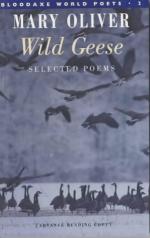
"Wild Geese," which first appeared in Mary Oliver's Dream Work, published in 1986, is one of the poet's most anthologized poems. It is also one of her most arresting. In it, she explores the connection between the human mind, nature in general, and wild geese in particular. Oliver is well noted for her poetry of the natural world, and she often relates animals and varieties of plant life to the human condition. Typical themes involve the beauty and wonders of nature and how much better the world would be if people were more in tune with it. In "Wild Geese," she encourages the reader to be more imaginative and to shed loneliness by discovering his or her place "in the family of things"namely, the family of sun and rain, prairies and trees, mountains, rivers, and, ultimately,~ wild geese flying home.
Although the premise of this poem may seem simple, or even trite, the real gut of its message is quite provocative. From its first linerife with intriguing ambiguitythe poem draws the reader in with a sense of immediacy and a keen awareness of how "you" may be feeling and what "you" may be thinking. This is a brief poem written in casual language, but it still manages to be stimulating and powerful. Not all poets can pull that off, but Oliver is one of the noted few who can.
Read more from the Study Guide
|
This section contains 233 words (approx. 1 page at 400 words per page) |
|




