
 Print
Print Word
Word PDF
PDF|
This section contains 297 words (approx. 1 page at 400 words per page) |

|
U.S.A. Summary & Study Guide Description
U.S.A. Summary & Study Guide includes comprehensive information and analysis to help you understand the book. This study guide contains the following sections:
This detailed literature summary also contains Bibliography on U.S.A. by John Dos Passos.
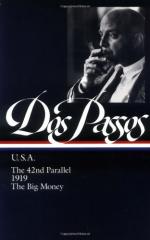
John Dos Passos wrote the three novels that make up the trilogy U.S.A. between 1927 and 1936, drawing on his own childhood and education, his service in the ambulance corps during World War I, and his left-wing political views of current events. The trilogy was first published as a whole in 1938. Dos Passos aimed to produce a satire on American life, permeated with popular songs, current events, and headlines, that would truly portray the whole of American culture and events. The trilogy spans the years from the opening of the twentieth century through the dawn of the Great Depression and expresses Dos Passos's view of the ill effects of capitalism on the American people.
The trilogy is notable for Dos Passos's use of various experimental techniques, such as the "Camera Eye," a series of stream-of-consciousness monologues that are inserted throughout the chapters; the "Newsreels," collages of headlines, lines from popular songs and pieces of current events; and twenty-seven biographies of typical or important people of the time. He had first developed some of these techniques in his earlier work, Manhattan Transfer, his first novel to receive widespread readership and critical attention. In using them, he was inspired by such disparate sources as the poems of Walt Whitman, the fragmented images of postimpressionist painting, James Joyce's Ulysses, and silent filmmakers D. W. Griffith and Sergei Eisenstein, who used montage, or contrasting scenes, to portray the busy and often ironic contrasts of the real world.
These techniques brought praise from critics of the time. Dos Passos's style of emphasizing history and current events in his narrative and his striving to produce an all-encompassing portrait of the America of his time influenced many later writers of the twentieth century, including Jean-Paul Sartre, Norman Mailer, and E. L. Doctorow.
Read more from the Study Guide
|
This section contains 297 words (approx. 1 page at 400 words per page) |
|




