
Forgot your password?  

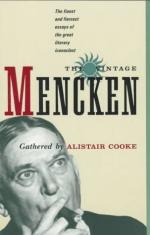
The Vintage Mencken | Quiz

This Study Guide consists of approximately 39 pages of chapter summaries, quotes, character analysis, themes, and more - everything you need to sharpen your knowledge of The Vintage Mencken.

The Vintage Mencken | Quiz

Students: Take our free The Vintage Mencken quiz below, with 25 multiple choice questions that help you test your knowledge. Determine which chapters, themes and styles you already know and what you need to study for your upcoming essay, midterm, or final exam. Take the free quiz now!

Teachers: The BookRags Lesson Plan contains hundreds of test and quiz questions, including multiple choice, short answer, and essay questions. Create your own quiz or test with our automatic test generator, or choose from our ready-to-go chapter quizzes, midterm tests, and final exams. Don’t waste time reinventing the wheel, get the Lesson Plan today!

Directions: Click on the correct answer.

1)

What quotation did Mencken borrow from Theodore Dreiser in "Cavia Cobaya"? (from 15-18)

Does a woman of considerable means ever want for a man of inconsiderable means?
Does a man of moderate means never aspire to great wealth?
Does the temperate, invulnerable man ever give in to the sins of alcohol?
Does the average strong, successful man confine himself to one woman?
2)

Complete the following aphorism found in "Sententiae": "Democracy is..." (from 45-49)

"...the weapon waved by the fairer sex."
"...the theory that the common people know what they want, and deserve to get it good and hard."
"...the application of love to money. Everybody's love."
"...the Declaration of Independence after a trip to the dentist for a full root canal."
3)

Which war was General John Pershing most famously involved in? (from 19-23)

World War I.
World War II.
The Civil War.
The War of the Roses.
4)

What dominated Puritanism, according to Mencken in "The National Letters"? (from 15-18)

Religious tomfoolery.
Free-thinking men of purpose.
The simple necessities of food, clothing, and shelter.
Fear, and the suspicion of art.
5)

Which man did Mencken dub the "Star-Spangled Man"? (from 19-23)

George Washington.
Woodrow Wilson.
John Pershing.
William Jennings Bryan.
6)

Why was early Christianity superior to modern Christianity, per "Holy Writ"? (from 24-28)

It featured more moral instructions.
It featured a lot less sermonizing.
Services took place in cold places, to ensure better concentration.
Early Christianity had a less strict interpretation of Biblical stories.
7)

Complete the following aphorism found in "Sententiae": "Adultery is..." (from 45-49)

"...the destruction of love, life, and money."
"...like a marriage with a bad cold."
"...a willingness to get what's yours."
"...the application of democracy to love."
8)

What was Mencken's epitaph? (from 45-49)

Give your mother a kiss, for me.
Remember what I said, not what I did.
Wink your eye at some homely girl.
This gravestone may alternately be used as a paperweight.
9)

Why did Mencken curse those who translated the Bible into English? (from 24-28)

They made many factual errors.
They made a host of grammatical errors.
They misinterpreted the principles of Jesus Christ.
They made the prose overly flowery and beautiful.
10)

In what way did Mencken mock General John Pershing? (from 19-23)

Mencken mocked Pershing for a recent bumbling speech.
Mencken brought to light the existence of Pershing's mistress.
Mencken felt the vast amount of medals pinned to Pershing's uniform makes the man look ridiculous.
Mencken made fun of a recent photograph of Pershing wrapped in an American flag.
11)

What would best describe how Mencken felt about stage acting? (from 35-39)

It is completely unworthy of the price of admission.
Like portrait painting, stage acting provides a window into the truth.
It stabs at the soul with genuine feeling.
It gladdens the heart with falsity.
12)

What happened when Mencken sent a junior reporter to get him liquor during the Republican National Convention? (from 24-28)

The reporter encountered drunken goons, and failed to get any liquor.
The convention organizers caught Mencken and toss him out.
The reporter stole liquor from an aristocrat's secret stash.
The junior reporter was arrested and spends the night in jail.
13)

According to Mencken, how did members of the lower class respond to Wilson? (from 19-23)

They responded to his lower class domestic policies.
They were attracted to his lofty rhetoric.
They "clapped like fools" at a recent speech.
They threw rotten vegetables at him at the convention.
14)

What was Roosevelt's strategy at the Democratic National Convention of 1932? (from 40-44)

He wished to rush motions through and bypass parliamentary procedures.
Roosevelt had a comic struggle to obtain the highest podium, so he might look the tallest.
He wished to delay as much as possible, and honor every minor parliamentary procedure.
He wished to bribe key officials for the nomination.
15)

In "The National Letters," what was the cause of all the "diseases" which afflict America? (from 15-18)

Organized religion.
The lack of a proper diet.
The presumption of guilt, rather than innocence, in legal matters.
The lack of a stable aristocracy.
16)

Which was NOT a challenge to the schoolboy Mencken mentioned in "Travail"? (from 35-39)

They were trying to learn things that are above their intellectual ability.
They were taught lessons no one has an interest in.
They were taught by teachers they don't respect.
They were forced to be babysat against their will.
17)

What was the general atmosphere of the Democratic National Convention of 1932, as reported by Mencken? (from 40-44)

A complete circus.
Like Mafia men meeting at a restaurant, as the politicians are all corrupt.
Quiet, like a gentlemen's club.
Stuffy and mannered.
18)

How would Mencken respond to the notion that William Jennings Bryan was an earnest man? (from 29-33)

He was earnest to the public, but in private he was a swindler and schemer.
Earnest or no, he did the right thing in the Scopes monkey trial.
He was not earnest; he was inherently two-faced.
He might have been earnest, but that was about his only admirable quality.
19)

How had Wallace behaved in "The Wallace Paranoia"? (from 45-49)

He was convinced there are Communist space aliens.
He had been a bumbler and an "ass."
He had managed difficult times with great elegance.
He was flirting with "most every thing in a dress."
20)

What point did Mencken make when referring to the picture of a French soldier who was deformed with multiple amputations in war? (from 45-49)

The French were brave people, indeed.
Mencken imagined that the soldier likely sought a glorious death in battle, but now has to live life in a pathetic state.
The soldier made the noblest of sacrifices, and will be remembered forever.
Mencken thought it was terribly sad that the man will not be able to walk into heaven.
21)

Which of the following describes an Anglo-Saxon soldier, according to Mencken? (from 24-28)

A tendency to be able to bore the enemy to death with a long speech.
A remarkable physical constitution.
A strong sense of tactics as well as strategy.
A cowardice and ready willingness to desert.
22)

How was plutocracy created, according to Mencken? (from 29-33)

From the corrupting influence of money.
From the ruins of proper aristocracy.
From a desperate and starving peasant class.
Through dictatorial grabs for power.
23)

What was the subject of "The Noble Experiment"? (from 24-28)

A scientific breakthrough Mencken reported on.
The Cuban revolution.
Drinking during Prohibition.
Voting during World War I.
24)

What aspect of old-time education did Mencken miss most in modern education? (from 35-39)

The tolling of the dinner triangle.
The charm of the one-room schoolhouse.
Corporal punishment.
The insistence on only male teachers.
25)

According to Mencken, the intellectual tradition of Whitman and Emerson had been transferred to which man? (from 15-18)

Van Wyck Brooks.
Theodore Dreiser.
Jose Miguel Gomez.
William Jennings Bryan.
Copyrights
The Vintage Mencken from BookRags and Gale's For Students Series. ©2005-2006 Thomson Gale, a part of the Thomson Corporation. All rights reserved.
Follow Us on Facebook
Homework Help
