
Forgot your password?  
Related Topics

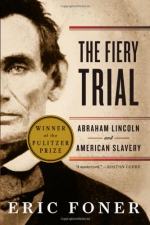
The Fiery Trial: Abraham Lincoln and American Slavery Quiz

This Study Guide consists of approximately 39 pages of chapter summaries, quotes, character analysis, themes, and more - everything you need to sharpen your knowledge of The Fiery Trial.

The Fiery Trial: Abraham Lincoln and American Slavery Quiz

Students: Take our free The Fiery Trial: Abraham Lincoln and American Slavery quiz below, with 25 multiple choice questions that help you test your knowledge. Determine which chapters, themes and styles you already know and what you need to study for your upcoming essay, midterm, or final exam. Take the free quiz now!

Teachers: The BookRags Lesson Plan contains hundreds of test and quiz questions, including multiple choice, short answer, and essay questions. Create your own quiz or test with our automatic test generator, or choose from our ready-to-go chapter quizzes, midterm tests, and final exams. Don’t waste time reinventing the wheel, get the Lesson Plan today!

Directions: Click on the correct answer.

1)

When did the Mexican-American War end? (from Chapter 3)

1865.
1846.
1833.
1848.
2)

Who was the sixth President of the United States? (from Chapter 9 and Epilogue)

John P. Hale.
John Quincy Adams.
Martin Van Buren.
John B. Henderson.
3)

When did the the Supreme Court hand down the Dred Scott Decision? (from Chapter 4)

1857.
1833.
1759.
1861.
4)

What was the first American political party, from the early 1790s to 1816? (from Chapter 3)

The Republican Party.
The Free Soil Party.
The Whig Party.
The Federalist Party.
5)

When was the Wisconsin Enabling Act enacted? (from Chapter 4)

1820.
1848.
1836.
1832.
6)

What nickname did Stephen A. Douglas have in politics? (from Chapter 5)

"Goliath."
"Little Giant."
"Giant Tortoise."
"The Great Bear."
7)

When the Thirteenth Amendment was proposed there had been no new amendments adopted to the Constitution in more than how many years? (from Chapter 9 and Epilogue)

50.
30.
40.
60.
8)

What clause in the Fourteenth Amendment prohibits state and local governments from depriving persons of life, liberty, or property without certain steps being taken to ensure fairness? (from Chapter 9 and Epilogue)

The Intermittent Clause.
The Equal Rights Clause.
The Due Process Clause.
The Discrimination Clause.
9)

When was Stephen A. Douglas born? (from Chapter 5)

1779.
1801.
1798.
1813.
10)

The Dred Scott Decision was a ruling by the U.S. Supreme Court that people of African descent brought into the United States and held as slaves (or their descendants) were what? (from Chapter 4)

Free to vote.
Freed men.
Not protected by the Constitution.
Protected by the Constitution.
11)

What is a foreign policy which holds that political rulers should avoid alliances with other nations, but still retain diplomacy, and avoid all wars not related to direct self-defense? (from Chapter 7)

Conventionalism.
Conservative interventionalism.
Diplomaticism.
Non-interventionism.
12)

The Constitutional Union Party was established in what year? (from Chapter 5)

1860.
1851.
1861.
1850.
13)

Illinois had prohibited slavery in its constitution in what year when it was admitted as a state? (from Chapter 4)

1848.
1819.
1832.
1836.
14)

Who was an anti-slavery activist who was active in the New York Committee of Vigilance and the Underground Railroad and helped Frederick Douglass escape to freedom? (from Chapter 8)

David Ruggles.
William Lloyd Garrison.
Martin Van Buren.
John P. Hale.
15)

James Buchanan was a member of what political party when he was elected U.S. President? (from Chapter 3)

The Republican Party.
The Federalist Party.
The Whig Party.
The Democratic Party.
16)

Lincoln's Preliminary Emancipation Proclamation offered gradual emancipation and what to border states and any states that returned voluntarily to the Union? (from Chapter 7)

Compensation.
The right to vote.
Freedom.
Consequences.
17)

When did Abraham Lincoln first meet with Frederick Douglass? (from Chapter 8)

August, 1863.
June, 1865.
September, 1864.
September, 1862.
18)

Who was a Confederate general during the American Civil War, and one of the best-known Confederate commanders after General Robert E. Lee? (from Chapter 6)

Henry Clay.
Clay Taylor.
Stonewall Jackson.
Zachary Taylor.
19)

The Thirteenth Amendment to the United States Constitution was adopted as law on what date? (from Chapter 9 and Epilogue)

April 8, 1864.
December 6, 1865.
January 31, 1865.
August 16, 1864.
20)

When was the Fourteenth Amendment to the United States Constitution adopted? (from Chapter 9 and Epilogue)

June 14, 1867.
July 9, 1868.
July 12, 1868.
September 1, 1868.
21)

What refers to the act of withdrawing from an organization, union, or especially a political entity? (from Chapter 5)

Embargo.
Indiscretion.
Succession.
Secession.
22)

In the context of the American Civil War, what refers to slave states that did not declare their secession from the United States before April 1861? (from Chapter 6)

Border states.
Middle states.
Undecided states.
The Confederacy.
23)

How many candidates did the Democratic Party present for the 1860 presidential election? (from Chapter 5)

0.
1.
2.
3.
24)

William H. Seward was the 12th governor of what state? (from Chapter 7)

Kentucky.
Illinois.
New York.
Indiana.
25)

Where was James Buchanan born? (from Chapter 3)

Pennsylvania.
Illinois.
Kentucky.
New York.
Copyrights
The Fiery Trial: Abraham Lincoln and American Slavery from BookRags and Gale's For Students Series. ©2005-2006 Thomson Gale, a part of the Thomson Corporation. All rights reserved.
Follow Us on Facebook
