
Forgot your password?  
Related Topics

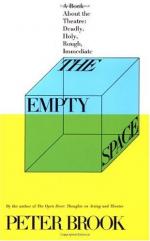
The Empty Space | Quiz

This Study Guide consists of approximately 31 pages of chapter summaries, quotes, character analysis, themes, and more - everything you need to sharpen your knowledge of The Empty Space.

The Empty Space | Quiz

Students: Take our free The Empty Space quiz below, with 25 multiple choice questions that help you test your knowledge. Determine which chapters, themes and styles you already know and what you need to study for your upcoming essay, midterm, or final exam. Take the free quiz now!

Teachers: The BookRags Lesson Plan contains hundreds of test and quiz questions, including multiple choice, short answer, and essay questions. Create your own quiz or test with our automatic test generator, or choose from our ready-to-go chapter quizzes, midterm tests, and final exams. Don’t waste time reinventing the wheel, get the Lesson Plan today!

Directions: Click on the correct answer.

1)

Who theorized the "Theatre of Cruelty"? (from The Holy Theatre, part 1 (p 47 to 61))

Jerzy Grotowski.
Bertolt Brecht.
Merce Cunningham.
Antoine Artaud.
2)

What is the third element for creating and defining theatre, according to the author, described as the life that an audience brings into the theatre every time a play is performed? (from The Immediate Theatre, part 2 (p 134 to 157))

Representation.
Assistance.
Repetition.
Truth.
3)

What "can be anywhere, any time, of any duration: nothing is required, nothing is taboo"? (from The Holy Theatre, part 2 (p 61-72))

A Happening.
An ordeal.
A violent outbreak.
An emotional moment.
4)

The author writes that "the theatre of the Absurd did not seek the ____ for its own sake." (from The Holy Theatre, part 1 (p 47 to 61))

Truth.
Realism.
Glory.
Unreal.
5)

What artist does the author refer to as a visionary who leads a theatre company in Poland? (from The Holy Theatre, part 2 (p 61-72))

Andreas Bryg.
Travis Kendowski.
Jerzy Grotowski.
Chaim Potok.
6)

The author writes of the architecture of theatres in saying, "as for theatres, the problem of design cannot start" how? (from The Rough Theatre, part 1 (p. 73 to 92))

Illogically.
Logically.
Demandingly.
Viscerally.
7)

In the author's "formula" for creating and defining theatre, the first element is what? (from The Immediate Theatre, part 2 (p 134 to 157))

Representation.
Truth.
Assistance.
Repetition.
8)

The author states, "When Brecht was alive, it was the ______ of West Berlin who flocked to his theatre in the East." (from The Immediate Theatre, part 2 (p 134 to 157))

Nobles.
Czars.
Intellectuals.
Anarchists.
9)

"In the theatre, the tendency for centuries has been to put the actor" where? (from The Holy Theatre, part 2 (p 61-72))

On a screen.
Close to us.
In the air.
At a remote distance.
10)

The theory of what is: "a spectator can be jolted eventually into new sight, so that he wakes to the life around him"? (from The Holy Theatre, part 2 (p 61-72))

Absurdism.
Surrealism.
Happenings.
Cruelty.
11)

For which Shakespearean play is it true that "as long as scholars could not decide whether this play was a comedy or not, it never got played"? (from The Rough Theatre, part 2 (p. 93 to 109))

King Lear.
Henry VIII.
The Tempest.
Measure for Measure.
12)

Who once did a production of Love's Labour's Lost where the character called Constable Dull was dressed as a Victorian policeman because his name at once conjured up the typical figure of the London bobby? (from The Rough Theatre, part 1 (p. 73 to 92))

Peter Brook.
Antoine Artaud.
Samuel Beckett.
Peter Sellers.
13)

Of what play does the author write, "The optimism of the lady buried in the ground is not a virtue, it is the element that blinds her to the truth of her situation"? (from The Holy Theatre, part 2 (p 61-72))

Waiting for Godot.
Happy Days.
Endgame.
Krapp's Last Tape.
14)

"If rehearsals are short, ______ is inevitable--but everyone deplores it, naturally," according to the author. (from The Immediate Theatre, part 1 (p 110 to 134))

Type-casting.
No direction.
Foregoing truth.
Casting.
15)

Who "wanted the theatre to contain all that normally is reserved for crime and war"? (from The Holy Theatre, part 1 (p 47 to 61))

Grotowski.
Beckett.
Jenet.
Artaud.
16)

In the cinema, who, according to the author, has single-handedly brought about a revolution by showing how relative the reality of a photographed scene can be? (from The Rough Theatre, part 2 (p. 93 to 109))

Godard.
Lynch.
Fellini.
Beckett.
17)

Who does the author describe as perhaps the most idiosyncratic of all theatre artists? (from The Immediate Theatre, part 1 (p 110 to 134))

Actors.
Critics.
Designers.
Directors.
18)

Who created the method termed "alienation" in the theatre? (from The Rough Theatre, part 1 (p. 73 to 92))

Brook.
Cunningham.
Brecht.
Beckett.
19)

From which of Shakespeare's plays is the line, "Wilt thou be gone? It is not yet near day", which the author uses as an example in "The Immediate Theatre"? (from The Immediate Theatre, part 2 (p 134 to 157))

King Lear.
Romeo and Juliet.
Hamlet.
A Winter's Tale.
20)

"Whenever one has a real critical flop, for the remainder of the run there is always a small audience of..." what? (from The Immediate Theatre, part 2 (p 134 to 157))

Cautious ticketpayers.
Great enthusiasm.
Grand critics.
Haters.
21)

What is the Haitian voodoo priest called? (from The Holy Theatre, part 2 (p 61-72))

The Krobodos.
The Magic Man.
The Voodoo.
The Houngan.
22)

What play was conceived by Peter Weiss, and based on many ideals of Brecht? (from The Rough Theatre, part 2 (p. 93 to 109))

Marat/Sade.
Ubu Roi.
The Screens.
The Investigation.
23)

Who allegedly saw a play for the first time in their lives and were confronted with Waiting for Godot with no problem at all in following what, to regular theatre-goers, was incomprehensible? (from The Rough Theatre, part 1 (p. 73 to 92))

The Chinese army.
A circus troupe.
San Quentin prisoners.
School children.
24)

Whose recent production of Coriolanus underlines the whole question of where illusion begins and ends, according to the author (and the time the book was written)? (from The Rough Theatre, part 2 (p. 93 to 109))

The Swan Theatre.
The Royal Shakespeare Company.
The Berliner Ensemble's.
Old Vic.
25)

What does the "inner man" express only in his words? (from The Holy Theatre, part 1 (p 47 to 61))

Anarchy and poetry.
Fear and desire.
Love and hatred.
Lust and rage.
Copyrights
The Empty Space from BookRags and Gale's For Students Series. ©2005-2006 Thomson Gale, a part of the Thomson Corporation. All rights reserved.
Follow Us on Facebook
Homework Help
