
 Print
Print Word
Word PDF
PDF|
This section contains 415 words (approx. 2 pages at 400 words per page) |

|
The Big Money Summary & Study Guide Description
The Big Money Summary & Study Guide includes comprehensive information and analysis to help you understand the book. This study guide contains the following sections:
This detailed literature summary also contains Bibliography on The Big Money by John Dos Passos.
John Dos Passos's The Big Money (1936) argues that the pursuit of the American dream ends in corruption. No matter what good intentions the characters possess, the desire for big money tarnishes, and eventually destroys, their authenticity. Dos Passos illustrates this idea by detailing the personal journey of each character and providing a sketch of an actual public figure whose life parallels, frames, or comments on the fictional characters' lives. For example, Dos Passos tells the story of Charley Anderson, an upstanding young mechanic who earned the Croix de Guerre during the War. Though Anderson starts out a simple mechanic, his longing for the American dream pushes him to a bigger and better career in aviation. Success, greed, and lust quickly lead to Charley's downfall. Dos Passos uses biographical pieces about famed inventors Henry Ford, Frederick Winslow Taylor, and Thorstein Veblen to put Charley's unhappy tale in context. The Big Money also showcases Dos Passos's subjective, stream-of-consciousness invention, the Camera Eye. Expressing an autobiographical viewpoint of sorts, the Camera Eye offers a fluid, first-person look at the world.
John Dos Passos is an author from the "Lost Generation," a term Gertrude Stein used to describe American bohemian-modernist writers of the 1920s and 1930s who lived in Europe during World War I and the Depression years. His novel The Big Money (1936) marks the end of that Lost Generation, a time of disillusionment, cynicism, and youthful idealism. Dos Passos, along with his fellow writers, witnessed the horrors of war and contemplated the true meaning of life and humanity, particularly in terms of American materialism and excess. Ironically, due to Dos Passos's changing political views, he became relatively unknown compared to Stein, Ernest Hemingway, Ezra Pound, and other members of the Lost Generation.
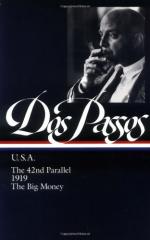
The Big Money is the third and final book in a series called the "U.S.A. Trilogy." Alfred Kazin in "Dos Passos, Society, and the Individual" calls The Big Money "the most ambitious" of the series. Stylistically speaking, The Big Money resembles the other two novels in the trilogy—42nd Parallel and 1919—by telling the stories of Mary French, Margo Dowling, Richard Ellsworth Savage, among others, through a stream-of-consciousness technique and a montage of biographical, journalistic, and fictional pieces. This fragmented style reflects the Lost Generation's uncertainty and search for self in a world where the future was no longer guaranteed. The "U.S.A. Trilogy," published after six years of writing, describes the eternal, and often unsuccessful, quest for the American dream.
Read more from the Study Guide
|
This section contains 415 words (approx. 2 pages at 400 words per page) |
|




