
Forgot your password?  

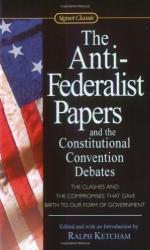
The Anti-Federalist Papers; and, the Constitutional Convention Debates Quiz

This Study Guide consists of approximately 38 pages of chapter summaries, quotes, character analysis, themes, and more - everything you need to sharpen your knowledge of The Anti-Federalist Papers; and, the Constitutional Convention Debates.

The Anti-Federalist Papers; and, the Constitutional Convention Debates Quiz

Students: Take our free The Anti-Federalist Papers; and, the Constitutional Convention Debates quiz below, with 25 multiple choice questions that help you test your knowledge. Determine which chapters, themes and styles you already know and what you need to study for your upcoming essay, midterm, or final exam. Take the free quiz now!

Teachers: The BookRags Lesson Plan contains hundreds of test and quiz questions, including multiple choice, short answer, and essay questions. Create your own quiz or test with our automatic test generator, or choose from our ready-to-go chapter quizzes, midterm tests, and final exams. Don’t waste time reinventing the wheel, get the Lesson Plan today!

Directions: Click on the correct answer.

1)

What did William Paterson offer the convention? (from Chapters 9-12)

The Virginia Plan.
The Missouri Compromise.
The Great Compromise.
The New Jersey Plan.
2)

What did "Cato" argue about the relationship between the legislature and the executive? (from Chapters 43-45, Appendices I and II)

He argued that they were proto-tyrannies.
He argued that they were too tightly associated.
He argued that they were not sufficiently checked by the judiciary.
He argued that centralized executive power was dangerous.
3)

What plan did James Madison favor? (from Chapters 13-16)

A federal plan.
A state-centric plan.
An isolationist plan.
A diplomatic plan.
4)

Where on the political spectrum were Alexander Hamilton's opinions? (from Chapters 9-12)

Closer to democracy than republicanism.
Closer to republicanism than democracy.
Closer to anarchy than democracy.
Closer to monarchy than democracy.
5)

What did Mr. Hamilton argue during the debate over the length of Senatorial term-lengths? (from Chapters 13-16)

Senators should appoint their successors.
Senators should serve for life to create continuity in government.
Senators should have long terms to stay above the fray.
Senators should have short terms in order to remain subject to their constituents.
6)

What method of ratification did Mason and Madison advocate? (from Chapters 21-24)

Ratification by straw poll.
Ratification by special conventions in each state.
Ratification by state legislature.
Ratification national referendum.
7)

What did "Cato" call for in the legislative branch? (from Chapters 43-45, Appendices I and II)

Judicial oversight.
Seven year terms for representatives.
Executive oversight.
Yearly elections for representatives.
8)

What did "Brutus" say was wrong with the term durations for the Senate and Supreme Court? (from Chapters 43-45, Appendices I and II)

He argued that Senators should serve for life.
He argued that judges should step down after fourteen years.
He argued that Senatorial terms are too long.
He argued that judges should be elected every two years.
9)

Why did delegates argue for a judicial veto power? (from Chapters 17-20)

To protect small states.
To correct bad laws.
To prevent corruption.
To prevent bad executive judgment.
10)

Where did James Madison argue government legitimacy came from? (from Chapters 13-16)

The righteousness of laws.
The power of the government.
Consent of the governed.
The political process itself.
11)

What did James Wilson argue regarding the abolition of trial by jury at the federal level? (from Part II: Ratification of the Constitution, Chapters 31-34)

He said that there would not be many cases where this applied.
He said that trial by military tribunal was just as fair.
He said that it would be compensated by strong protections at the state level.
He said it was not a general problem.
12)

What limitation did delegates try to place on suffrage? (from Chapters 21-24)

Landowner restrictions.
National origin restrictions.
Literacy restrictions.
Race restrictions.
13)

Which constituents did Dr. Johnson want to placate with the plan he advocated? (from Chapters 13-16)

Federalists.
Small states.
The upper classes.
Foreign diplomats.
14)

What was the Pennsylvania dissenters' primary objection to the Constitution? (from Chapters 35-38)

A free government cannot govern so large and disparate an area.
The lack of restrictions on the government's ability to tax the people.
The strength of the federal government.
The lack of a bill of rights.
15)

What did Alexander Hamilton propose in his speech? (from Chapters 9-12)

A standing army.
Regulation of slavery.
A Supreme Court.
An executive-for-life.
16)

What symbol did Benjamin Franklin remark on, on the President's chair? (from Chapters 29-30)

A sun painted on the back.
A pine tree.
An ocean and a ship.
An eagle on the seat.
17)

What did the Pennsylvania dissenters recommend to the Constitutional Convention? (from Chapters 35-38)

Trial by jury in property conflicts.
Limitations on the expansion of the United States.
Trial by jury in all federal cases.
A standing army that would still exist in peacetime.
18)

What was eliminated from the Constitution draft? (from Chapters 25-28)

Laws governing territories and provinces.
Restriction on imports.
Property qualifications for office.
Protections against taxes on slavery.
19)

Who was "Brutus"? (from Chapters 39-42)

A Massachusetts anti-Federalist.
Robert Yates, probably.
Melancton Smith.
No one knows for sure.
20)

What did "Brutus" advocate concerning a system of checks and balances? (from Chapters 43-45, Appendices I and II)

He argued that executive power is too strong.
Checks and balances by a power superior to any of the branches.
He argued that the judiciary is not independent enough.
He argued that Congress should not have oversight of judicial nominations.
21)

What did James Madison recommend for the appointment of Supreme Court Justices? (from Chapters 17-20)

That judges should be appointed for seven-year terms.
That judges should be elected.
That appointments be beyond contest.
That appointments be susceptible to two-thirds vote override by the Congress.
22)

What powers did Mr. Mason argue the Congress should not have? (from Chapters 29-30)

The power to alter the budget.
The power to originate budget bills.
The power to recall the executive.
The power to reject judicial nominations.
23)

What did the convention call for on July 26? (from Chapters 21-24)

Proposals for executive term limits.
A committee to resolve the Virginia Plan and the New Jersey plan.
A committee to write a draft of the agreed-upon points.
A vote on ratification.
24)

How did Benjamin Franklin interpret the symbol on the President's chair? (from Chapters 29-30)

He saw it as a predator subduing its enemies.
He saw it as a tree withstanding the storms.
He saw it as a sun rising over the republic.
He saw it as a symbol of commerce.
25)

Why did Mr. Wilson prefer the New Jersey Plan? (from Chapters 9-12)

Because it provided multiple legislative houses.
Because it provided for a standing army.
Because it centralized power in the executive.
Because it protected America from European influence.
Copyrights
The Anti-Federalist Papers; and, the Constitutional Convention Debates from BookRags and Gale's For Students Series. ©2005-2006 Thomson Gale, a part of the Thomson Corporation. All rights reserved.
Follow Us on Facebook
Homework Help
