
Forgot your password?  
Related Topics

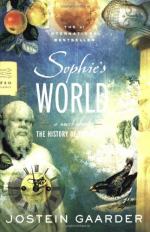
Sophie's World | Quiz

This Study Guide consists of approximately 74 pages of chapter summaries, quotes, character analysis, themes, and more - everything you need to sharpen your knowledge of Sophie's World.

Sophie's World | Quiz

Students: Take our free Sophie's World quiz below, with 25 multiple choice questions that help you test your knowledge. Determine which chapters, themes and styles you already know and what you need to study for your upcoming essay, midterm, or final exam. Take the free quiz now!

Teachers: The BookRags Lesson Plan contains hundreds of test and quiz questions, including multiple choice, short answer, and essay questions. Create your own quiz or test with our automatic test generator, or choose from our ready-to-go chapter quizzes, midterm tests, and final exams. Don’t waste time reinventing the wheel, get the Lesson Plan today!

Directions: Click on the correct answer.

1)

What are Indo-European myths about? (from Chapter 13, the Postcards, Chapter 14, Two Cultures)

The galaxy.
Nature.
Physical ailments.
Many Gods.
2)

What is in the Major's first envelope from Hilde? (from Chapter 34, Counterpoint)

A picture of her mirror.
A note concerning the Mercedes.
Money.
A message from Sophie.
3)

After Sophie returns home from meeting Alberto, what does she see in the mirror? (from Chapter 16, the Renaissance)

Her reflection, with another girl behind.
Two girls, face to face.
The Major and Hilde.
Her mother and grandmother.
4)

What is a sign of Europe's renewed progress in the 1200s? (from Chapter 15, the Middle Ages)

Equal rights for all.
The infant mortality rate drops.
Increased travel.
The building of the Cathedrals.
5)

Politically, what is the Baroque period characterized with? (from Chapter 17, the Baroque)

Waste and vulgarity.
Anger and ignorance.
Assassinations and revolts.
Peace and equality.
6)

What is Berkeley's theory toward perceptions? (from Chapter 22, Berkeley)

All people should only trust their own.
He doubts them all.
They don't really exist.
God should guide us, not perceptions.
7)

What are Sophie and Alberto's lives like after their adventures in the binder end? (from Chapter 34, Counterpoint)

They travel the world.
They retreat to the cabin.
They disappear.
They see people, but the people cannot see or hear them.
8)

What does the Big Bang theory propose? (from Chapter 35, the Big Bang)

God created humans similar to animals.
The sun will shut off one day.
An explosion developed the universe.
The universe cannot continue to expand.
9)

What situation does Alberto apply Hume's argument to? (from Chapter 20, Locke, Chapter 21, Hume)

Parents vs. children.
Workers vs. factory owners.
Political leaders vs. the general public.
Environmentalist sentiments vs. economic development.
10)

Sophie dreams about Hilde's golden crucifix and then wakes to be startled by what? (from Chapter 16, the Renaissance)

Joanna's board game on her bed.
Alberto in his dress.
Hilde's crucifix under her pillow.
Hermes standing over her.
11)

What does Kierkegaard accuse Hegel of doing? (from Chapter 28, Kierkegaard)

Stealing from the wealthy.
Conforming to society's standards.
Using the ignorance of the mass to his advantage.
Abandoning thoughts of the individual.
12)

What is Hilde's birthday present from her father? (from Chapter 23, Bjerkely)

A ring binder with the typed text of a book.
Embroidered scarves.
A diamond necklace.
An ivory jewelry box.
13)

Overall, what are the philosophers of the Baroque period like? (from Chapter 17, the Baroque)

Mediocre students.
Extreme idealists.
Enlightened classists.
Conservative realists.
14)

Why is it important the Major may not know the real meaning of his unconscious thoughts and desires? (from Chapter 31, Freud)

That gives Alberto and Sophie a chance to escape.
That allows him to do well at his job.
That makes Hilde able to lie to him.
That makes him susceptible to a writing error.
15)

What do the Arabs develop in the 1200s? (from Chapter 15, the Middle Ages)

Early recording systems.
Writing.
Moving pictures.
Science.
16)

What is the role of a philosopher, according to Hegel? (from Chapter 27, Hegel)

To be the mirror that reflects the ideas of his or her own time.
To feed and clothe those in need.
To teach those that are discouraged.
To question all that come to him.
17)

What do surrealists say about art? (from Chapter 31, Freud)

It should be a blend of the conscious and the unconscious mind.
Its effectiveness determines its value.
It is unnecessary for people to make art.
It must appeal to a select group.
18)

For what are Alberto and Sophie going to use practical reason? (from Chapter 25, Kant)

To meet the Philosophers.
To trick Hilde.
To escape.
To earn money.
19)

What change happens after Sophie's mother introduces Alberto to the gathering at the garden party? (from Chapter 33, the Garden Party)

Alberto crashes the party.
The party starts to get wild.
Everyone becomes scared and goes home.
They all leave because they know they aren't real.
20)

How does man see galaxies? (from Chapter 35, the Big Bang)

As inconsequential stars.
As they appeared millions of years ago.
As gifts from God.
As moving targets.
21)

What does Hume say people's feelings are not based on? (from Chapter 20, Locke, Chapter 21, Hume)

Tradition.
History.
Experience.
Reason.
22)

What does Aladdin bring when he visits Alberto and Sophie? (from Chapter 26, Romanticism)

His genie.
A pitchfork and saw.
His wand and potion.
A pot of gold.
23)

Why does the point of view switch to Hilde? (from Chapter 23, Bjerkely)

Alberto needs to teach Sophie full time.
Sophie died.
Hilde really exists.
The Major neglected Hilde's point of view.
24)

Hegel states that prior philosophies search for what? (from Chapter 27, Hegel)

Desires.
Hope.
Universals.
Needs.
25)

What guise does Sophie arrange so she can meet Alberto in person? (from Chapter 15, the Middle Ages)

She spends the night at Joanna's house.
She joins a church.
She has activities after school.
She goes to a movie theatre.
Copyrights
Sophie's World from BookRags and Gale's For Students Series. ©2005-2006 Thomson Gale, a part of the Thomson Corporation. All rights reserved.
Follow Us on Facebook
Homework Help
