
 Print
Print Word
Word PDF
PDF|
This section contains 198 words (approx. 1 page at 400 words per page) |

|
Ring around the Moon Summary & Study Guide Description
Ring around the Moon Summary & Study Guide includes comprehensive information and analysis to help you understand the book. This study guide contains the following sections:
This detailed literature summary also contains Bibliography and a Free Quiz on Ring around the Moon by Jean Anouilh.
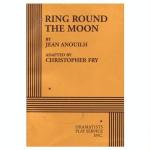
Jean Anouilh's Ring Around the Moon first appeared in France in 1947 as L 'Invitation au Chateau. Especially important in Anouilh's career, the play is the earliest of his pieces brillantes, a rather mixed group of four works moving from two lighter to two darker pieces. Brilliantes has been employed to describe the polished and sophisticated gemlike quality of this group, most prominently displayed in Ring Around the Moon's complex plotting, ceaseless obstacles, and still after all the reconciliation of almost all of its characters to both love and wealth.
Perhaps because of its parody of upper-class vanity Ring Around the Moon is Anouilh's most produced play in the United States, where there is a tradition of holding the aristocracy in contempt. The play's numerous characters engaged in ceaseless exiting and entrancing enhance the quick-paced wit and tangy satire of upper-class pretension and lower-class ambition. Yet Ring Around the Moon is unexpectedly coupled to a fairy tale ending where nearly everything comes out better. For this reason, Ring Around the Moon, like some of Shakespeare's comedies, succeeds on the level of both entertainment and art just one reason Anouilh is Europe's most popular post-World War II playwright.
Read more from the Study Guide
|
This section contains 198 words (approx. 1 page at 400 words per page) |
|




