
Forgot your password?  

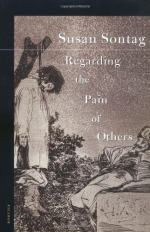
Regarding the Pain of Others Quiz

This Study Guide consists of approximately 25 pages of chapter summaries, quotes, character analysis, themes, and more - everything you need to sharpen your knowledge of Regarding the Pain of Others.

Regarding the Pain of Others Quiz

Students: Take our free Regarding the Pain of Others quiz below, with 25 multiple choice questions that help you test your knowledge. Determine which chapters, themes and styles you already know and what you need to study for your upcoming essay, midterm, or final exam. Take the free quiz now!

Teachers: The BookRags Lesson Plan contains hundreds of test and quiz questions, including multiple choice, short answer, and essay questions. Create your own quiz or test with our automatic test generator, or choose from our ready-to-go chapter quizzes, midterm tests, and final exams. Don’t waste time reinventing the wheel, get the Lesson Plan today!

Directions: Click on the correct answer.

1)

In interpreting photographs, Sontag claims that everyone approaches the image as which of the following? (from Chapter 4)

A critic.
A realist.
An idealist.
A literalist.
2)

Which of the following produced a documentary about a "deranged" Pacific war veteran who drives the streets of Tokyo speaking against Japanese war crimes? (from Chapter 10)

Theodore Dreiser.
Kazuo Hara.
Larisa Shepitko.
Jeff Wall.
3)

Who took the infamous image of Brigadier General Nguyen Ngoc Loan executing a Vietcong suspect in the street? (from Chapter 5)

Eddie Adams.
Roger Fenton.
Timothy O'Sullivan.
Roger Capa.
4)

Sontag argues that we are most disappointed to discover that which type of photographs have been staged? (from Chapter 4)

Images depicting spontaneous events.
Images depicting gory battle scenes.
Images depicting everyday life.
Images depicting intimate climaxes.
5)

A heated debate emerged when a weekly paper in Boston ran a video of which American journalist's execution in Pakistan? (from Chapter 5)

Eddie Adams.
Don McCullin.
Daniel Pearl.
Ariel Sharon.
6)

Sontag suggests that it is still possible to "feel the pulse of Christian iconography" in much war photography. Which famous work of art does she suggest can be seen in W. Eugene Smith's photograph of the woman in Minamata cradling her child? (from Chapter 6)

Descent from the Cross.
The Pieta.
The Passion of Christ.
The Last Supper.
7)

Which of the following is an account of a man's last hours before his execution at the guillotine? (from Chapter 10)

"The Hours."
"The Ascent."
"The Green Mile."
"The Execution of Troppmann."
8)

Which nation's army was represented in Wall's photograph? (from Chapter 10)

Afghanistan.
United States.
Soviet Union.
Iraq.
9)

Sebastiao Salgado's work called "Migrations: Humanity in Transition" was often criticized as being: (from Chapter 6)

"Exploitative."
"Melodramatic."
"Generalizing."
"Cinematic."
10)

Discussing the "co-spectatorship" and "indecency" of the image of the Vietcong suspect's execution, Sontag asserts which of the following? (from Chapter 5)

General Loan was unaware of the cameras at the time of the execution.
The presence of journalists was an invasion of the executed man's privacy.
The shooting would not have occurred in the absence of journalists to record it.
The photographer arranged the execution in advance.
11)

Modern society, Sontag argues, is a "society of _______". (from Chapter 8)

Sympathy.
Sheep.
Shock.
Spectacle.
12)

Events enter the collective memory, not by a natural process of remembering but by: (from Chapter 6)

Active designation of significance.
Government propaganda.
Repeated exposure.
Subconscious selection.
13)

U.S. bombing of Afghanistan was conducted remotely from which of the following locations? (from Chapter 5)

The Pentagon.
Tampa, Florida
Quantico, Virginia.
Washington, D.C.
14)

For Sontag, the impression that there are more news of atrocity is probably which of the following? (from Chapter 9)

An illusion.
An obnoxious overstatement.
A regrettable truth.
An accurate perception.
15)

Photographic representations of the Vietnam War was essential to promoting: (from Chapter 4)

International relations.
Patriotic sentiment.
New methods of communication.
The anti-war movement.
16)

Sontag cites one of her earlier books published in 1977. Which of the following is it? (from Chapter 8)

"On Photography."
"Reborn."
"Illness as Metaphor and AIDS and Its Metaphors."
"Against Interpretation."
17)

Sontag suggests that to make peace is to do which of the following? (from Chapter 9)

Forget.
Understand.
Remember.
Forgive.
18)

Contemporary society, at the time Sontag wrote the book, unanimously witnessed a rise of which of the following in the media? (from Chapter 7)

Sadism and sexuality.
War protest.
Violence and sadism.
Violence and sexuality.
19)

Sontag claims that the model for public space in modern society is which of the following? (from Chapter 10)

The memorial.
The mega-store.
The debate hall.
The classroom.
20)

How many soldiers did Wall's photograph depict? (from Chapter 10)

Three.
Thirteen.
Five.
Twelve.
21)

Many of the scenes in "Saving Private Ryan" were based on works by which famous World War I photographer? (from Chapter 6)

Gilles Peress.
Ernst Friedrich.
Roger Fenton.
Robert Capa.
22)

Sontag writes that provocative images may have which of the following effects on viewers? (from Chapter 7)

Provocative images may spur viewers to examine how their own privileges are possible through the suffering of others.
Provocative images of suffering may incite humanitarian actions to end exploitative actions.
Provocative images of suffering may compel viewers to stop subscribing to newspapers for fear of seeing more disturbing photographs.
Provocative images of suffering may enable a deep sense of human empathy.
23)

Sontag claims that shock used for rhetorical purposes can become _________. (from Chapter 6)

New.
Dangerous.
Familiar.
Damaging.
24)

Sontag argues that which of the following effects keeps the television viewer's attention "light", "mobile" and fairly "indifferent" to the images on the screen? (from Chapter 8)

Media coverage.
Advertising.
Image-glut.
Overload.
25)

The Brady war pictures were taken of which of the following wars? (from Chapter 4)

The American Civil War.
The Crimean War.
The Spanish Civil War.
World War I.
Copyrights
Regarding the Pain of Others from BookRags and Gale's For Students Series. ©2005-2006 Thomson Gale, a part of the Thomson Corporation. All rights reserved.
Follow Us on Facebook
