
Forgot your password?  
Related Topics

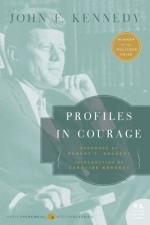
Profiles in Courage | Quiz

This Study Guide consists of approximately 86 pages of chapter summaries, quotes, character analysis, themes, and more - everything you need to sharpen your knowledge of Profiles in Courage.

Profiles in Courage | Quiz

Students: Take our free Profiles in Courage quiz below, with 25 multiple choice questions that help you test your knowledge. Determine which chapters, themes and styles you already know and what you need to study for your upcoming essay, midterm, or final exam. Take the free quiz now!

Teachers: The BookRags Lesson Plan contains hundreds of test and quiz questions, including multiple choice, short answer, and essay questions. Create your own quiz or test with our automatic test generator, or choose from our ready-to-go chapter quizzes, midterm tests, and final exams. Don’t waste time reinventing the wheel, get the Lesson Plan today!

Directions: Click on the correct answer.

1)

Besides the Texas territory which Benton opposed, what other one did he support against his party's stand? (from Chapter 4)

Alaska.
Montana.
California.
Oregon.
2)

Who was the author of the words, it is not true, in fact, that any people ever existed who love the public better than themselves? (from Chapter 11)

Benjamin Franklin.
John Adams.
Thomas Jefferson.
John Hancock.
3)

Who served as the Governor of Tennessee and later as Senator from the State of Texas? (from Chapter 5)

Sam Houston.
Stephen A. Austin.
Henry Calhoun.
Thomas Hart Benton.
4)

What act of inconsistency brought his Missouri constituents to brand him a traitor? (from Chapter 4)

His willingness to allow the country to go to war.
His voting with the Republicans.
His opposition to the Missouri Compromise.
His opposition to annexting Texas.
5)

What is the irony of Houston's defending the Northerner's rights to abolition? (from Chapter 5)

Houston was a slave to the Cherokee.
Houston disliked all Yankees.
Houston owned slaves himself.
Houston opposed slavery except in the South.
6)

How many votes were needed to convict the President? (from Chapter 6)

54.
36.
40.
66.
7)

From the list of profiles in courage selected by Kennedy, is there some common reason behind their courage? (from Chapter 11)

Yes. It is a matter of common motivation to be president.
Possibly, if we look hard enough at each one.
Of course. It all has to do with their upbringing.
No. The reasons always seem to elude us.
8)

What was the famous put down of historian T. B. Macaulay by Prime Minister Melborne? (from Chapter 11)

Macaulay changes opinions like most people change socks.
All I can say about Macaulay is that there are few things wholly good or wholly bad.
I would like to be as sure of anything as Macaulay seems to be of everything.
Macaulay simply does not understand politics or politicians.
9)

Under what law was President Andrew Johnson tried in the Congress? (from Chapter 6)

The Articles of Confederation.
The Bill of Rights.
The Civilian Code.
The Articles of Impeachment.
10)

What made Sam Houston a household word in the United States? (from Chapter 5)

He was a greater orator than Daniel Webster.
He ran for president in 1856 but did not win the Democratic nomination.
He was leader of the Texas forces that defeated Mexico at the battle of San Jacinto.
He became known for the Houston knife he invented.
11)

What was leaked to the newspapers that did away with American public resistance to the Armed Ship Bill? (from Chapter 8)

The Mexican conspiracy.
The Kaiser's war zone warning.
The sinking of the Titanic.
The Zimmerman note.
12)

How did Ross describe his feelings just before he cast his not guilty vote? (from Chapter 6)

I looked down at my open grave.
I felt the chill of fear on my spine.
I had a great lump in my throat.
I was afraid I could not speak.
13)

What is ironic about Texas secession on March 2? (from Chapter 5)

It was the day Houston became governor.
It was Houston's brithday.
It was the anniversary of the battle of San Jacinto.
It was the anniversary of Houston's election to the Senate.
14)

Taft's words on freedom of thought, freedom from orthodox dogma, and the right to think for oneself are his definition of what? (from Chapter 9)

Liberalism.
Unitarianism.
Socialism.
Conservatism.
15)

Although thought of as a crazy politician, what did John F. Kennedy see as a mark of courage in the man? (from Chapter 4)

He would do whatever was necessary to get re-elected.
He would stand up in the Senate without a gun.
His stance on big government over states' rights.
He would do what he thought was right regardless of his party or his popularity.
16)

What was the Armed Ship Bill? (from Chapter 8)

It provided for arming neutral American merchant ships.
It provided for ships to supply weapons for the Allies in Europe.
It provided a large tax increase to build upthe navy.
It provided for US Navy action while claiming neutrality.
17)

What memorable line did the Toledo BLADE print about Taft after he decried the Nuremberg trials? (from Chapter 9)

He has a wonderful mind that knows practically everything and understands practically nothing.
That Taft wanted to let loose on the world a terrible gang of cutthroats.
He has no feeling about the soup kitchens of 1932 but supports Nazi criminals.
This is not the time to weaken the punishment of international crimes.
18)

What was Lamar's involvement in the controversial Hayes-Tilden presidential election? (from Chapter 7)

He refused to fight the election results.
He voted against the Democrats and supported Hayes.
He supported an election commission that eventually gave Hayes the Presidency.
He made stump speeches for Hayes.
19)

What was the Jay Treaty and why did President Washington support it? (from Chapter 10)

It was a treaty to buy arms and munitions only from the British.
It was a treaty with Great Britain that President Washington supported to keep the young country from going to war.
It was a treaty giving land west of the Mississippi to the British.
It was a treaty removing all taxes from British imports supported by Washington to protect the rich.
20)

What does Kennedy have to say about his book and independence? (from Chapter 11)

It is all about excessive adherence to what one perceives as true.
It is not an attempt to justify independence for the sake of independence.
It is all liberalism versus conservatism.
It shows independence as merely stubborn conflict.
21)

What was Ross' military experience? (from Chapter 6)

The Union Army and the Union Navy.
The Ohio Militia and the Confederate Army.
The Republic of Texas Army and the Union Army.
The Kansas Free State Army and the Union Army.
22)

What high office did Lamar hold at the end of his career? (from Chapter 7)

Justice of the Supreme Court.
Head of the Democratic National Committee.
Vice-President of the United States.
Secretary of the Interior.
23)

Why was Ross targeted for surveillance and harassment before the Johnson trial. (from Chapter 6)

Stanton thought he could intimidate Ross with his military connections.
Both sides believed he was weak willed.
He kept silent on how he might vote.
He was using his secret to gain political notariety.
24)

What method did Sen. Norris use to prevent the passage of the Armed Ship Bill? (from Chapter 8)

A Petition.
Buried in committee.
Filibuster.
Collecting enough votes to defveat it.
25)

What was Benton's characteristic that early on made his constituents love him? (from Chapter 4)

His fearlessness.
His political favors.
His sense of humor.
His humble nature.
Copyrights
Profiles in Courage from BookRags and Gale's For Students Series. ©2005-2006 Thomson Gale, a part of the Thomson Corporation. All rights reserved.
Follow Us on Facebook
