
Forgot your password?  
Related Topics

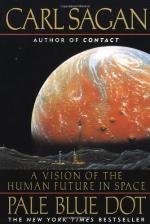
Pale Blue Dot: A Vision of the Human Future in Space Quiz

This Study Guide consists of approximately 34 pages of chapter summaries, quotes, character analysis, themes, and more - everything you need to sharpen your knowledge of Pale Blue Dot (book).

Pale Blue Dot: A Vision of the Human Future in Space Quiz

Students: Take our free Pale Blue Dot: A Vision of the Human Future in Space quiz below, with 25 multiple choice questions that help you test your knowledge. Determine which chapters, themes and styles you already know and what you need to study for your upcoming essay, midterm, or final exam. Take the free quiz now!

Teachers: The BookRags Lesson Plan contains hundreds of test and quiz questions, including multiple choice, short answer, and essay questions. Create your own quiz or test with our automatic test generator, or choose from our ready-to-go chapter quizzes, midterm tests, and final exams. Don’t waste time reinventing the wheel, get the Lesson Plan today!

Directions: Click on the correct answer.

1)

What material that humans have added to the environment would be easily detectable from space? (from Chapter 5, Is There Intelligent Life on Earth?, Chapter 6, The Triumph of Voyager)

Plastics.
Methane.
Chlorofluorocarbons.
Carbon dioxide.
2)

What type of government is Sagan most opposed to? (from Chapter 21, To The Sky!, Chapter 22, Tiptoeing Through the Milky Way)

Fascism.
Theocracy.
Socialism.
Plutocracy.
3)

Many of organic molecules arrived on Earth from what source? (from Chapter 7, Among the Moons of Saturn, Chapter 8, The First New Planet)

Asteroids.
Meteors.
Comets.
Space dust.
4)

What unusual source of energy do the Voyager spacecraft take advantage of? (from Chapter 5, Is There Intelligent Life on Earth?, Chapter 6, The Triumph of Voyager)

Solar wind.
Cosmic rays.
Vacuum energy.
Planetary gravity.
5)

According to Sagan, how do early Earth and Titan compare? (from Chapter 7, Among the Moons of Saturn, Chapter 8, The First New Planet)

They are only vaguely related.
They are almost exactly the same.
They are similar.
They are totally different.
6)

Which of the following is NOT one of the ways that early planets may have been made incapable of bearing life? (from Chapter 9, An American Ship at the Frontiers of the Solar System, Chapter 10, Sacred Black)

Falling into the sun.
Being heavily bombarded by meteors.
Being thrown into outer space.
Being pushed into a distant orbit.
7)

Sagan cautions that the beliefs he endorses could lead to an overabundance of what? (from Chapter 21, To The Sky!, Chapter 22, Tiptoeing Through the Milky Way)

Pride.
Technology.
Population.
Confidence.
8)

Sagan suggests that humans could live and thrive around what unusual type of star? (from Chapter 21, To The Sky!, Chapter 22, Tiptoeing Through the Milky Way)

White dwarfs.
Pulsars.
Brown dwarfs.
Nova nuclei.
9)

What does Neptune's moon have less of compared to Titan? (from Chapter 9, An American Ship at the Frontiers of the Solar System, Chapter 10, Sacred Black)

Iron.
Carbon.
Potassium.
Ice.
10)

Conditions of what type were extremely important in the creation of early life on Earth? (from Chapter 7, Among the Moons of Saturn, Chapter 8, The First New Planet)

Littoral.
Aquatic.
Atmospheric.
Geological.
11)

What does Martian soil seem to contain? (from Chapter 15, The Gates of the Wonder World Open, Chapter 16, Scaling Heaven)

Methane.
Ice.
Oil.
Organic material.
12)

Earth will most likely lose contact with the Voyager probes when what happens? (from Chapter 9, An American Ship at the Frontiers of the Solar System, Chapter 10, Sacred Black)

Their radio transmitters die.
They pass the troposphere.
They reach the Kuiper belt.
Their solar cells die.
13)

The Voyager probes found large amounts of what element on Titan? (from Chapter 7, Among the Moons of Saturn, Chapter 8, The First New Planet)

Oxygen.
Nitrogen.
Iridium.
Helium.
14)

Why do some suggest capturing asteroids in Earth orbit? (from Chapter 17, Routine Interplanetary Violence, Chapter 18, The Marsh of Camarina)

To mine them for resources.
To use them as weapons.
To use them as space stations.
To study them.
15)

Which planet was Voyager 2 intended to visit first? (from Chapter 5, Is There Intelligent Life on Earth?, Chapter 6, The Triumph of Voyager)

Venus.
Mars.
Mercury.
Jupiter.
16)

The primary discipline that Sagan argues nations benefit from by investing in space exploration is called which of the following? (from Chapter 13, The Gift of Apollo, Chapter 14, Exploring Other Worlds and Protecting This One)

Planetary science.
Gestalt geosurveying.
Interstellar surveying.
Atmospheric metrics.
17)

According to the plans Sagan discussed, how would nuclear weapons typically be used to stop an asteroid from colliding with the Earth? (from Chapter 17, Routine Interplanetary Violence, Chapter 18, The Marsh of Camarina)

By pushing it off-course.
By reversing its orbit.
By splitting it in two.
By destroying it completely.
18)

How old are the terrain features generated by Venus' volcanoes? (from Chapter 11, Evening and Morning Star, Chapter 12, The Ground Melts)

4 billion years.
2 billion years.
500 million years.
1 billion years.
19)

When did NASA's SETI program go online? (from Chapter 19, Remaking the Planets, Chapter 20, Darkness)

1996.
1992.
1984.
1978.
20)

How far out does the solar corona die out? (from Chapter 21, To The Sky!, Chapter 22, Tiptoeing Through the Milky Way)

1200 AU.
550 AU.
70 AU.
5 AU.
21)

What is Neptune's largest moon? (from Chapter 9, An American Ship at the Frontiers of the Solar System, Chapter 10, Sacred Black)

Ariadne.
Eurydice.
Europa.
Triton.
22)

According to Sagan, what was the major advantage of the attitude of the government towards the Apollo project? (from Chapter 13, The Gift of Apollo, Chapter 14, Exploring Other Worlds and Protecting This One)

There was plenty of funding for space.
New propulsion systems were developed.
Computers advanced in power rapidly.
Rocket science progressed quickly.
23)

The records on the Voyager craft are most like what type of information storage method? (from Chapter 9, An American Ship at the Frontiers of the Solar System, Chapter 10, Sacred Black)

A telegraph code.
Magnetic data storage.
A phonograph.
Braille.
24)

According to Sagan, how profitable is it for a nation to invest in space exploration? (from Chapter 13, The Gift of Apollo, Chapter 14, Exploring Other Worlds and Protecting This One)

It has high costs.
It is not related to a nation's welfare.
It is highly profitable.
It has great benefits in a limited scope.
25)

Besides the Voyager spacecraft, what does Sagan cite as a major triumph by NASA? (from Chapter 5, Is There Intelligent Life on Earth?, Chapter 6, The Triumph of Voyager)

The Hubble Telescope.
The Gemini project.
The moon landings.
The Mars rovers.
Copyrights
Pale Blue Dot: A Vision of the Human Future in Space from BookRags and Gale's For Students Series. ©2005-2006 Thomson Gale, a part of the Thomson Corporation. All rights reserved.
Follow Us on Facebook
