
Forgot your password?  

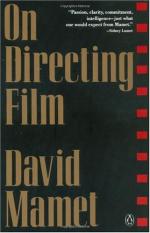
On Directing Film | Quiz

This Study Guide consists of approximately 28 pages of chapter summaries, quotes, character analysis, themes, and more - everything you need to sharpen your knowledge of On Directing Film.

On Directing Film | Quiz

Students: Take our free On Directing Film quiz below, with 25 multiple choice questions that help you test your knowledge. Determine which chapters, themes and styles you already know and what you need to study for your upcoming essay, midterm, or final exam. Take the free quiz now!

Teachers: The BookRags Lesson Plan contains hundreds of test and quiz questions, including multiple choice, short answer, and essay questions. Create your own quiz or test with our automatic test generator, or choose from our ready-to-go chapter quizzes, midterm tests, and final exams. Don’t waste time reinventing the wheel, get the Lesson Plan today!

Directions: Click on the correct answer.

1)

Mamet's house was built without what? (from Chapter 3: Countercultural Architecture and Dramatic Structure)

Metal.
Brick.
Wood.
Nails.
2)

What does Mamet say that dramatic analysis is like in Chapter 6? (from Chapater 6: Conclusion)

Critical thinking.
Plotting a compass course.
Literary analysis.
Solving a math equation.
3)

According to Mamet in Chapter 3, "You tax the audience every time you don't move on to _______ of the progression as quickly as possible." (from Chapter 3: Countercultural Architecture and Dramatic Structure)

The next essential step.
The MacGuffin.
The essential truth.
The action.
4)

In ADR, what does D stand for? (from Chapter 3: Countercultural Architecture and Dramatic Structure)

Drive.
Dictation.
Density.
Dialogue.
5)

According to Mamet in Chapter 3, the only thing the dramatic form is good for is what? (from Chapter 3: Countercultural Architecture and Dramatic Structure)

Character creation.
Artistic expression.
Telling a story.
Political gain.
6)

Mamet made the analogy in Chapter 4, "if the house is going to stand, the nail must do the work of ____." (from Chapter 4: The Tasks of the Director)

A beam.
A nail.
A slat.
A hammer.
7)

What, in approaching the task of film, do we not have to do all at once, in Mamet's analogy in Chapter 6? (from Chapater 6: Conclusion)

Swim the ocean.
Float a river.
Build the house in a day.
Climb the whole mountain.
8)

According to Mamet in Chapter 6, it is the pursuit of what that is important? (from Chapater 6: Conclusion)

Creativitiy.
Beauty.
An ideal.
Truth.
9)

What do you refer to when giving direction to the actor or the cameraman? (from Chapter 4: The Tasks of the Director)

The actor's focus.
The beat.
The interesting shot.
The objective of the scene.
10)

What does Mamet say most modern art is based around? (from Chapter 3: Countercultural Architecture and Dramatic Structure)

Poetry.
Creativity.
Political reasons.
Self-indulgence.
11)

Which story of the farmer's did the class decide to go with in Chapter 5? (from Chapter 5: Pig—The Movie)

Getting money for food.
Saving the child.
Having no money.
Getting rid of danger.
12)

Mamet says in Chapter 4 that movies are made out of what? (from Chapter 4: The Tasks of the Director)

Very simple ideas.
Elaborate stories.
Heroic struggles.
Epic dramas.
13)

According to Mamet in Chapter 3, "To get into the scene late and to get out early is to demonstrate _____ for your audience." (from Chapter 3: Countercultural Architecture and Dramatic Structure)

Honor.
Respect.
Truth.
Empathy.
14)

What was the steamboat captain's answer to Stanislavsky, in Chapter 6? (from Chapater 6: Conclusion)

"I stick to the channel; it's marked."
"I have a sounding beacon."
"I drink a lot of water."
"I use a map."
15)

Mamet says in Chapter 3 that it is the nature of human perception to go to what? (from Chapter 3: Countercultural Architecture and Dramatic Structure)

The MacGuffin.
The back-story.
The protagonist.
The most interesting thing.
16)

What does Mamet say is useless filler in film, and the giveaway to a joke's punch line, in Chapter 5? (from Chapter 5: Pig—The Movie)

Exposition.
Obstacle.
Drama.
Signposts.
17)

What did Stanislavsky ask the steamboat captain, according to Mamet in Chapter 6? (from Chapater 6: Conclusion)

How he steered the boat safely.
How he maintained a living.
How he kept from getting seasick.
How he didn't get lost.
18)

According to Mamet, what actor did he laud for his simplicity in a scene which involved the Nazis, in Chapter 4? (from Chapter 4: The Tasks of the Director)

Clifton Hayes.
James Stewart.
Humphrey Bogart.
Carey Grant.
19)

Mamet says of film directing and screenwriting that they are what? (from Chapater 6: Conclusion)

Controlling.
The same trade.
Very different.
Exact sciences.
20)

Stanislavsky wrote that the difficult will become easy and the easy habitual, so that the habitual may become what? (from Chapater 6: Conclusion)

Honest.
Beautiful.
True.
Exact.
21)

According to Mamet in Chapter 4, "If you don't know what you want, how can you know when _____?" (from Chapter 4: The Tasks of the Director)

To edit.
To stop.
To begin.
You're done.
22)

Everything in the old cartoons was based on what, according to Mamet? (from Chapter 5: Pig—The Movie)

Imagination.
Plot.
Individual expression.
Ink.
23)

What does David Mamet say that the answer to all of the tedious actor questions is? (from Chapter 4: The Tasks of the Director)

Look at the text.
Based on the objective.
It doesn't matter.
Quickly.
24)

Mamet recommended the book A Practical Handbook for the Actor, written by whom? (from Chapter 5: Pig—The Movie)

Mamet, Eisenstein, Olnek.
Bruder, Eisenstein.
Bruder, Cohn, Olnek, et al.
Meisner, Adler, et al.
25)

What is another term for "looping"? (from Chapter 3: Countercultural Architecture and Dramatic Structure)

ADR.
Voiceover.
Steadicam.
Editing.
Copyrights
On Directing Film from BookRags and Gale's For Students Series. ©2005-2006 Thomson Gale, a part of the Thomson Corporation. All rights reserved.
Follow Us on Facebook
Homework Help
