
 Print
Print Word
Word PDF
PDF|
This section contains 189 words (approx. 1 page at 400 words per page) |

|
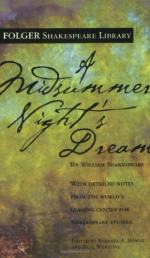
A Midsummer Night's Dream Summary & Study Guide Description
A Midsummer Night's Dream Summary & Study Guide includes comprehensive information and analysis to help you understand the book. This study guide contains the following sections:
This detailed literature summary also contains Further Study and a Free Quiz on A Midsummer Night's Dream by William Shakespeare.
Widely recognized as a comic masterpiece, A Midsummer Night's Dream is one of Shakespeare's most popular works. The play has inspired numerous adaptations, including Felix Mendelssohn's acclaimed musical score for a nineteenth-century production. Written about 1595, A Midsummer Night's Dream is considered Shakespeare's first mature comedy. By blending motifs from various classical works, such as the first-century Roman poet Ovid's Metamorphoses and the second century Roman orator Apuleius's Golden Ass, the playwright successfully balanced a variety of narrative styles and dramatic procedures to create an unforgettable artistic effect. The plot of A Midsummer Night's Dream is Shakespeare's own, however: he did not follow his usual practice of adapting an older story. This account of the tribulations of a love quadrangle during a night of madness imaginatively combines ambiguous allusions, wordplay, sinister hints, fragments of noble poetry, and profound meditations on the nature of art and love. The brilliant characterization, richness of language, and compositional complexity of this play have provided critics and commentators with material for much theorizing. As for the general reader and theater-goer, A Midsummer Night's Dream remains a timeless and limitless source of aesthetic pleasure.
Read more from the Study Guide
|
This section contains 189 words (approx. 1 page at 400 words per page) |
|




