
 Print
Print Word
Word PDF
PDF|
This section contains 438 words (approx. 2 pages at 400 words per page) |

|
The Man Who Turned Into a Stick Summary & Study Guide Description
The Man Who Turned Into a Stick Summary & Study Guide includes comprehensive information and analysis to help you understand the book. This study guide contains the following sections:
This detailed literature summary also contains Bibliography and a Free Quiz on The Man Who Turned Into a Stick by Kobo Abe.
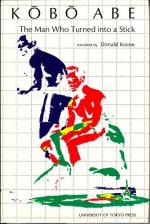
The first performance of The Man Who Turned into a Stick was staged at Kinokuniya Hall in Tokyo in 1967. However, it was not until Kobo Abe directed the play in his own Kobo Abe Studio in 1976 that the play reached, in Abe's mind, a level of completion. Whenever Abe presented The Man Who Turned into a Stick, a short, one-act play, he joined it to two other short plays; but in the 1976 version, a new and more specific sequence came to Abe's mind, one he believed made the three-play set more comprehensive. The individual plays in the revised series were then given subtitles. The first play of the set, The Suitcase, was subtitled Birth; the second play, The Cliff of Time, was subtitled Process; and the third, The Man Who Turned into a Stick was given the subtitle Death.
Even with the subtitle suggesting a theme, The Man Who Turned into a Stick is not a play that is easily understood, and many people believe that that is exactly how Abe wanted it. Abe did not like to write plays for passive audiences. He wanted his audiences to work. He liked that his plays made people feel uncomfortable because he believed that it was through this discomfort that people would begin to question their own lives rather than perfunctorily accept their fate. In The Man Who Turned into a Stick, he not only presents obscure characters and dialogue that demand attention, he deliberately ends his play with one of the characters pointing directly at the audience and telling the people sitting there that they all resemble sticks. The audience must therefore participate in the play and consider its meaning on a more personal level.
Abe enjoyed complexities and ambiguities because he believed that it was through confronting uncertainty that people would break out of their rigid (or stick-like), preprogrammed thoughts. His plays are built upon dreamlike images, uneasy to grasp. As Abe told Nancy Shields in her book Fake Fish, "The more we become free from the framework of reality the more clearly we get the real experience which corresponds to the fake experience in a dream." That this statement is not easy to comprehend is also typical of Abe. In essence, however, these sentiments are the backbone upon which The Man Who Turned into a Stick was built. In Abe's metaphor, the rigidity of staunchly held beliefs that contradict one's existence causes people to turn into sticks. A stick is dead and inflexible. By taking the ordinary object of a stick and personifying it, Abe hoped to shake his audiences out of their "fake dreams."
Read more from the Study Guide
|
This section contains 438 words (approx. 2 pages at 400 words per page) |
|




