
 Print
Print Word
Word PDF
PDF|
This section contains 1,022 words (approx. 3 pages at 400 words per page) |

|
Mama Day Summary & Study Guide Description
Mama Day Summary & Study Guide includes comprehensive information and analysis to help you understand the book. This study guide contains the following sections:
This detailed literature summary also contains Topics for Discussion on Mama Day by Gloria Naylor.
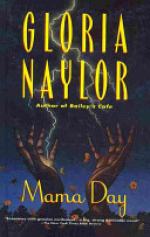
Mama Day is a novel by Gloria Naylor, the American Book Award-winning author of The Women of Brewster Place. This novel follows the lives of Miranda (Mama) Day and her family. Mama Day is told in both third person (Mama Day’s story) and in the first person, in a dialogue between Mama Day’s grandniece Ophelia (Cocoa) Day, and her husband, George Andrews.
The Days are descendants of slaves, freed in 1823 by their master Bascombe Wade when he died and deeded to them his entire holdings: a private island off the coast of South Carolina and Georgia called Willow Springs. Though its beginnings are shrouded in mystery, Mama Day, the matriarch of the island, helps keep the island’s unique heritage alive. Her sister Abigail is her only living relative on the island, as Abigail’s granddaughter Cocoa has gone “mainside” and is living in New York City.
Although they seem to have nothing in common, Cocoa finds love with a straitlaced engineer named George Andrews who, himself, has a past hidden in shadows. Upon visiting the island, Cocoa and George find themselves confronted with mysterious happenings, difficult situations, and devastating loss. However, the citizens of Willow Springs persevere in a place that seems set outside of time: a place of struggle and survival over forces both natural and supernatural.
Preface
The preface of the book begins with a family tree depicting the Day Family, and a bill of sale detailing the purchase of a female slave, Sapphira, who is suspected of using witchcraft.
Readers are introduced to Willow Springs, an island that belongs to no country, but only to its inhabitants. In 1823, Bascombe Wade died, freed his slaves, and left everything he owned to Sapphira and her descendants, who live there to this day.
After the preface, the book is broken into two parts: I and II.
Part I
After noticing one another in a coffee shop, Cocoa applies for a job at George’s company. The interview is awkward, and she does not get the job. However, after writing him a letter, he anonymously suggests her to a business associate for a job. Eventually, he asks her for a date and they develop a friendship, which later evolves into a more romantic one. They have many differences, and for several years they vacation separately, Cocoa spending her vacations on the island of Willow Springs with her family.
Cocoa’s grandmother Abigail and great-aunt Miranda (Mama Day) live on Willow Springs. Mama Day is a wise-woman and healer who is respected above all others on the island.
The novel has two major subplots, which are introduced in part I. The first concerns a young woman, Bernice Duvall, who is desperate to have a child and elicits Mama Day’s help. Dissatisfied with the initial results, she takes matters into her own hands with disastrous consequences. Mama Day steps in and offers to help if only Bernice will follow her guidance. Eventually, with Mama Day’s help, Bernice becomes pregnant.
The second subplot concerns another neighbor, Ruby, who is suspected of using supernatural means to steal another woman’s lover. She is extremely possessive and prone to jealousy, suspicion, and revenge. Some even say she is prone to murder. Everyone she sees as a threat is in danger of coming to harm. Eventually, most of the town begins to avoid both her and her new husband.
Part II
After four years, George and Cocoa visit Willow Springs together. He is welcomed into the family and community. The Day women inform George and Cocoa they plan to throw a party for the couple to celebrate their visit. In the meantime, George gets to know the tales and traditions of the island, even though he doesn’t completely understand them.
Bernice and her husband have had a son. Bernice is very protective of him, but cannot prevent tragedy from striking when he is killed during a tropical storm.
Ruby’s possessiveness has become twisted and vicious. Any woman who comes too close is in danger. When she suspects Junior Lee has his eyes on Cocoa, she turns her ire on the younger woman with vicious consequences. However, Ruby underestimates the consequences of messing with someone Mama Day loves.
George and Cocoa fight before the storm hits. At the party thrown for them, they are not speaking to each other and Junior Lee takes this opportunity to hit on Cocoa. Ruby sees this, and, feigning sympathy, invites Cocoa over to have her hair done.
The storm hits, bringing George and Cocoa together again. However, when Cocoa awakes, she finds she has come down with a mysterious illness. Mama Day realizes quickly that Ruby has done something to her Baby Girl, and goes to confront her. When Ruby refuses to come out to meet her, Mama Day delivers retribution.
The storm has caused massive damage, including the death of Little Caesar Duvall and the destruction of the bridge to the mainland. George is obsessed with repairing the bridge, and threatens to swim across if needed (impossible as he cannot swim) in order to get help for his wife.
Mama Day instructs Dr. Buzzard to tell George about the hoodoo that has been performed on Cocoa. George refuses to believe, even when Mama Day tells him the same thing and plus adding the fact Cocoa is dying. When he finds a maggot from Cocoa’s body, he decides to return to Mama Day, who sends him to perform an unusual task. In his attempt to do what she asks, he falls victim to a heart attack, during which he goes to Cocoa and holds her as he dies.
Cocoa is cured, although she despairs over the loss of her husband. Mama Day returns with her to New York to clean out their apartment, and Cocoa moves to Charleston. She eventually remarries and has children.
At 104 years old, Mama Day knows she is dying, and savors the moments left in her life. She knows Cocoa is merely at the beginning of her journey, and is comforted now they have both found their peace.
Read more from the Study Guide
|
This section contains 1,022 words (approx. 3 pages at 400 words per page) |
|




