
 Print
Print Word
Word PDF
PDF|
This section contains 298 words (approx. 1 page at 400 words per page) |

|
Lord Jim Summary & Study Guide Description
Lord Jim Summary & Study Guide includes comprehensive information and analysis to help you understand the book. This study guide contains the following sections:
This detailed literature summary also contains Bibliography and a Free Quiz on Lord Jim by Joseph Conrad.
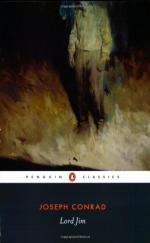
Joseph Conrad's Lord Jim, first published in Eng-land in 1900, has long been acknowledged as a very difficult book for readers to understand, especially on the first read. However, those who have taken the time to understand the book acknowledge that the effort is worth it. Lord Jim, which Conrad began as a short sketch, grew into a novel that is widely recognized for its modernism—its tendency to buck the conventional narrative trends of its day. The most obvious technique that Conrad used was a shifting form of narration, in which the reader hears a tale first from one narrator, then another, and finally from several disparate accounts.
Like many Conrad novels, this book features autobiographical elements from Conrad's own naval past. The story concerns a young man named Jim, who undertakes the training to become a naval officer, but his certificate is revoked when he deserts his ship during a crisis, leaving eight hundred Moslem pilgrims to what he thinks is a certain death—although the pilgrims live to tell the tale of his cowardice. Jim continually runs from this past, eventually to Patusan, a remote island in the Far East. Here, Jim starts fresh, earning the respect of the natives, who call him Lord Jim and attribute his many successes to supernatural powers. Jim must face the fears from his old life, however, and his ability to finally do this leads to the novel's tragic and ambiguous ending. Conrad's tale is so complex and open to individual interpretation that many critics have noted that the book has no one meaning and that it is all based on a paradox. However, this ambiguity has captivated readers for over a hundred years, and since its publication, many have regarded the book as Conrad's best.
Read more from the Study Guide
|
This section contains 298 words (approx. 1 page at 400 words per page) |
|




