
 Print
Print Word
Word PDF
PDF|
This section contains 256 words (approx. 1 page at 400 words per page) |

|
The Interpretation of Dreams Summary & Study Guide Description
The Interpretation of Dreams Summary & Study Guide includes comprehensive information and analysis to help you understand the book. This study guide contains the following sections:
This detailed literature summary also contains Bibliography and a Free Quiz on The Interpretation of Dreams by Sigmund Freud.
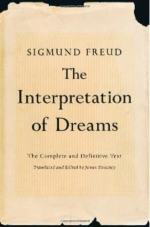
Sigmund Freud (1856-1939) is universally considered the "father" of psychoanalysis, and many date the birth of psychoanalytic theory from the 1899 publication of The Interpretation of Dreams (copyright 1900). Although Freudian theory, since its inception, has been relentlessly attacked from all sides, critics and proponents alike agree that Freud's ideas have exerted a profound influence on twentieth-century thought and culture.
Throughout The Interpretation of Dreams, Freud analyzes his own dreams as examples to prove his new theory of the psychology of dreams. Freud makes a distinction between the "manifest," or surface-level, dream content and the "latent," or unconscious, "dream thoughts" expressed through the special "language" of dreams. He posits that all dreams represent the fulfillment of a wish on the part of the dreamer and maintains that even anxiety dreams and nightmares are expressions of unconscious desires. Freud explains that the process of "censorship" in dreams causes a "distortion" of the dream content; thus, what appears to be trivial nonsense in a dream, can, through the process of analysis, be shown to express a coherent set of ideas. The "dream work" is the process by which the mind condenses, distorts, and translates "dream thoughts" into dream content. Freud proposes that the ultimate value of dream analysis may be in revealing the hidden workings of the unconscious mind.
The Interpretation of Dreams presents Freud's early theories in regard to the nature of the unconscious dream psychology, the significance of childhood experiences, the psychic process of "censorship," the "hieroglyphic" language of dreams, and the method he called "psychoanalysis."
Read more from the Study Guide
|
This section contains 256 words (approx. 1 page at 400 words per page) |
|




