
 Print
Print Word
Word PDF
PDF|
This section contains 663 words (approx. 2 pages at 400 words per page) |

|
In Cold Blood Summary & Study Guide Description
In Cold Blood Summary & Study Guide includes comprehensive information and analysis to help you understand the book. This study guide contains the following sections:
This detailed literature summary also contains Quotes and a Free Quiz on In Cold Blood by Truman Capote.
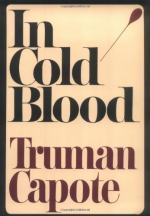
In Cold Blood is the ninth published work by celebrated writer, Truman Capote. This work is Capote’s attempt to create the nonfiction genre, a new direction in publishing in its time. In this book, Capote explores the true story of the murders of the Clutter family in rural Kansas. The Clutters were found in their home on the morning of November 15, 1959. They had been bound and shot. News of this murder spread throughout the community, causing fear and outrage, as the search for the killers unfolded. Capote follows this search, as well as the capture, confession, and trial of the two men responsible. In Cold Blood is a first of its kind, true crime narrative that continues to be controversial even as it approaches the fiftieth year of its publication.
Herb Cutter was a well-known and much respected wheat farmer in rural Kansas. A college educated man, Cutter once held a position as the Finney County agricultural agent. However, as a born farmer, Cutter settled down to own his own farm/ranch, River Valley Ranch. Here, Cutter raised cattle and wheat, as well as four children, Eveanna, Beverly, Nancy, and Kenyon. Cutter also cared for his long ailing wife, Bonnie.
The last day anyone saw Herb Cutter alive was on November 14, 1959. He had spent that day working on his farm, attending a local 4-H meeting, and buying a large insurance policy to care for his farm in the event of his death. It was an ordinary day that his daughter wrote about in her diary with simple, direct statements.
The following morning, a family friend who made a habit of attending church with the Cutter family, arrived at the house to find it unusually silent. This friend, also called Nancy, went with her father to ask another friend who also attended church with the Cutters if something had happened to cause the family to sleep in. Together the two girls returned to the Cutter home to find their friend, sixteen year old Nancy Cutter, bound and shot. Upon the arrival of the police, the bodies of the remaining three Cutters still living at home were found. They were the bodies of Herb Cutter, Bonnie Cutter, and Kenyon Cutter.
Immediately upon the news of the murders, people in the small town of Holcomb began to fear their neighbors, convinced someone local could be the only possible suspect. A special unit of the Kansas Bureau of Investigation was formed specifically to investigate the case. In fact, Alvin Dewey became so obsessed with the case that it took a physical toll on him.
As Dewey and his team searched for clues as to who might have had motive to kill the Clutters, the killers fled first to Mexico and then to various points across the southern states, including Florida and Texas, before finally getting caught in Las Vegas with critical evidence tying them to the case. A tip from a former cell mate of killer, Dick Hickock, led to the pursuit of Hickock and his partner, Perry Smith. Upon arrest, Hickock made a full confession, pinning the murders on Smith. Smith refused to confess until he learned that Hickock had told police a story Smith himself had told to Hickock in confidence during their brief time as cellmates in prison. Smith then confessed to the crime, matching Hickock’s story closely until he claimed that Hickock killed Nancy and Bonnie. Smith would later try to retract this part of his confession.
Hickock and Smith were put on trial for the murders of the Clutter family in the spring of 1960. After their conviction, Hickock and Smith were taken to the Federal Penitentiary in Leavenworth County, Kansas, to await their execution. The executions were delayed multiple times as Hickock wrote to, and finally convinced, a few lawyers that their trial was unconstitutional and to fight for a new one. Once all their appeals were denied, however, Hickock and Smith were hung on April 14, 1965.
Read more from the Study Guide
|
This section contains 663 words (approx. 2 pages at 400 words per page) |
|




