
 Print
Print Word
Word PDF
PDF|
This section contains 626 words (approx. 2 pages at 400 words per page) |

|
I Have a Dream Summary & Study Guide Description
I Have a Dream Summary & Study Guide includes comprehensive information and analysis to help you understand the book. This study guide contains the following sections:
This detailed literature summary also contains Bibliography on I Have a Dream by Martin Luther King, Jr..
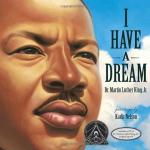
Martin Luther King Jr. delivered his "I Have a Dream" speech on August 28, 1963, at the March on Washington for Jobs and Freedom. Many regard it as the greatest speech of the twentieth century and, more than that, one of the greatest speeches in history. Though King was one of several featured speakers that day, "I Have a Dream" became synonymous with the aims of the march and the entire civil rights movement. His dream represented the dream of millions of Americans demanding a free, equal, and just nation.
A scholar and a pastor, King was able to combine academic, political, and biblical elements in his "I Have a Dream" speech. He referenced the Bill of Rights, the Declaration of Independence, the Emancipation Proclamation, and the Bible. When delivering his address, he spoke with accessible language and used repetition to drive home important points; the phrase "I have a dream" is repeated nine times in the speech. Though King had a script in front of him, as the speech progressed and the crowd responded, he began to improvise his message. The "I have a dream" section of the speech is the most well-known portion of the address, and it was entirely extemporaneous. The power of this section is a testament to King's oratory skills and the conviction with which he spoke. Just as his namesake Martin Luther sparked the Protestant Reformation in the sixteenth century, King and his "I Have a Dream" speech emboldened his followers and changed history.
In the speech, King demands the same justice and equality for black Americans that is promised to all citizens in the Declaration of Independence. While he calls on fellow civil rights activists to persevere in the face of brutality, violence, and oppression, he also cautions against the use of violence. King believed in what Henry David Thoreau termed "civil disobedience," in which individuals use nonviolent means to achieve social change, and studied Mahatma Gandhi's peaceful protests for Indian independence in the 1930s and 1940s. "Again and again," he counsels the crowd, "we must rise to the majestic heights of meeting physical force with soul force."
Television played an important role in delivering King's speech to the masses. Recent events in the civil rights struggle had been televised, including police brutality in Birmingham, Alabama, earlier in 1963, and television had become an important catalyst for the civil rights movement. The March on Washington, including King's speech, was broadcast live throughout the country. This allowed leaders like King to reach a new demographic. As William G. Thomas III writes in "Television News and the Civil Rights Struggle":
They had talked to the converted and they had talked to the irreconcilable, but it was the vast mass of Americans who either had no opinion of the matter or did not yet care that they needed to reach.
"I Have a Dream" comprises a large part of King's legacy. Portions of the speech are instantly recognizable and have become part of America's culture. King's dream became the nation's dream, and it did not die when he was assassinated in 1968. That year, his widow Coretta Scott King founded the King Center for Nonviolent Social Change in Atlanta, Georgia, as a way of furthering her husband's work for change. In 1986, King became the only twentieth-century figure whose birthday has been designated a public holiday, celebrated on the third Monday of January. However, it was not until 1993 that Martin Luther King Day was celebrated in all fifty states.
The text of "I Have a Dream" is widely available on the Internet and is collected in several anthologies and books, including I Have a Dream: Writings and Speeches That Changed the World, by Martin Luther King, and the American Rhetoric website at www.americanrhetoric.com.
Read more from the Study Guide
|
This section contains 626 words (approx. 2 pages at 400 words per page) |
|




