
 Print
Print Word
Word PDF
PDF|
This section contains 245 words (approx. 1 page at 400 words per page) |

|
The House of Blue Leaves Summary & Study Guide Description
The House of Blue Leaves Summary & Study Guide includes comprehensive information and analysis to help you understand the book. This study guide contains the following sections:
This detailed literature summary also contains Bibliography and a Free Quiz on The House of Blue Leaves by John Guare.
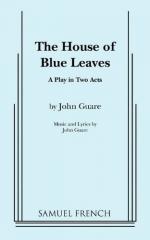
John Guare's The House of Blue Leaves is his most popular and arguably most important play. It is based on the Pope's visit to New York City on October 4, 1965.
Since the debut of The House of Blue Leaves Off-Broadway on February 10, 1971, however, critics have been divided over the play's artistic merits. The story focuses on one man's desire for success as a big-time songwriter, which clashes with his demanding, middle-class family life. Some reviewers did not know what to make of the play's mix of black comedy, farce, realistic drama, and social commentary. They maintained that its come-dic elements undermined the serious issues of the play.
The critics that praised The House of Blue Leaves appreciated Guare's treatment of ideas. They also lauded the manner in which he depicted the dark underside of the American dream, especially his emphasis on the destructive nature of the media on people's dreams and personal lives. Several critics noted the skillful manner in which Guare portrayed the quest for personal success as defined by a shallow value system.
Despite the controversy, the play ran for 337 performances and garnered several prestigious awards for Guare, including the Obie and New York Drama Critics Circle Award for Best American Play. Revived on Broadway in 1986, it won more awards for him, including a Tony. Although critics were still divided over the value of The House of Blue Leaves during the revival, most appreciated the power and insight of Guare' s message.
Read more from the Study Guide
|
This section contains 245 words (approx. 1 page at 400 words per page) |
|




