
 Print
Print Word
Word PDF
PDF|
This section contains 1,044 words (approx. 3 pages at 400 words per page) |

|
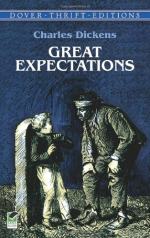
Great Expectations Summary & Study Guide Description
Great Expectations Summary & Study Guide includes comprehensive information and analysis to help you understand the book. This study guide contains the following sections:
This detailed literature summary also contains Topics for Discussion on Great Expectations by Charles Dickens.
The novel follows the life of Pip, an orphan who goes from being the unwanted ward of his forlorn sister to becoming a young man of means. However, when Pip learns who his benefactor is, he finds himself traveling down a road he never expected to take. Great Expectations is a story of a young man who wants more than what he is only to discover that what he had was not so bad.
Pip is playing in the cemetery in the marshes near his home. Pip is studying the graves of his parents when a convict surprises him. The convict turns Pip upside down, looking for food. After finding a piece of bread and eating it, the convict sends Pip home with orders to return in the morning with more food and a file.
Pip goes home and sets aside his own dinner for the convict. The next morning, Pip steals several food items his sister has set aside for Christmas dinner before going back to the cemetery to find the convict. Pip finds another convict before finding his own waiting for him. Pip gives him the food and file and tells him what he has seen.
Later, at Christmas dinner, Pip is frightened of what will happen when his sister learns he has taken a pie she had purposely put away for her special guests. Just as his sister discovers the missing pie, a group of soldiers come to the door looking for a blacksmith to fix a pair of leg irons. After fixing the leg irons, Pip’s brother-in-law, Joe, agrees to go with the soldiers to search for the missing convicts. Pip goes along. When they find the convicts, Pip manages to signal to the convict that he is not responsible for his being found. Later, the convict tells the soldiers and Joe that he broke into the blacksmith’s house and stole some food, saving Pip from any punishment his sister might wish to exact on him.
Sometime later, Pip is told by his sister and Mr. Pumblechook, Joe’s uncle, that Miss Havisham wants Pip to come play at her house. Miss Havisham is a rich, eccentric woman who lives in Rochester, the market-town near Pip’s village. Mrs. Joe sees this as a chance for Pip to bring wealth and prestige on her, so she forces him to comply. Pip is taken to the gate of Miss Havisham’s house for the first time by Mr. Pumblechook, who is quickly turned away at the gate by Estella, Miss Havisham’s adopted daughter. Pip is taken into the house and introduced to Miss Havisham, an older woman who wears her old wedding gown and has sealed the rooms of her house to remain the way they were the day her fiancée left her at the altar.
Pip plays cards with Estella but is not ignorant to the way she looks down on him and the words of Miss Havisham, encouraging him to fall in love with Estella so that she might shatter his heart the way her own fiancée did hers. Pip suddenly becomes aware of his poverty and his harshness, becoming embarrassed and determined to better himself. For the next year and a half, Pip continues to visit Miss Havisham, always aware of Estella’s poor opinion of him. Finally Miss Havisham calls Joe to her and pays him what Pip has earned in his visits to her and sends him off to be apprenticed to Joe’s blacksmith shop.
For the next few years Pip works in Joe’s blacksmith shop, but he is terribly unhappy. At night Pip studies books he has come across, hoping to better himself. One night, Joe and Pip come home to discover that Pip’s abusive sister has been attacked, suffering a head injury that leaves her mentally altered. Joe arranges for a young girl, Biddy, to come and care for his wife in her infirmity. Biddy and Pip become good friends and work together in trying to further their education. Then one night a lawyer comes to the village and tells Pip that an anonymous benefactor has decided to bestow property on Pip and turn him into a gentleman.
Pip goes to London to study with a tutor, who happens to be a relation of Miss Havisham. In London, Pip becomes good friends with a young man he once beat up in a boxing match at Miss Havisham’s, a man by the name of Herbert Pocket. Together, Pip and Herbert create a great amount of debt as they live the life of bachelors. At the same time, Pip befriends the clerk at his guardian’s office and through him creates a partnership in a shipping company for Herbert.
Estella comes back into Pip’s life and Pip finds himself under the assumption that Miss Havisham is Pip’s benefactor, having hope of making a match between him and Estella. However, when Estella falls in love with a fellow student who Pip deeply dislikes, he is heartbroken. Later, Pip learns that Miss Havisham was not his benefactor. Pip’s true benefactor is Abel Magwitch, the convict he once gave food and a file to. At first Pip is horrified by this revelation and wants nothing better than to escape from Magwitch. However, Pip soon learns that Magwitch is being hunted by his partner in crime and in danger of dying should he be found to have returned to England. Pip decides to help Magwitch. However, their attempt to escape the country fails and Magwitch is arrested, sentenced to death, and dies of injuries received in his escape attempt, penniless.
Pip finds himself without a benefactor and in great debt. Joe comes to his rescue, despite Pip’s poor treatment of him over the past few years. Pip decides to return to Joe and marry Biddy but discovers that Joe has asked Biddy to be his wife. Pip goes overseas to be a clerk in Herbert’s business. Pip works his way up to become a third partner in the business. After many years, Pip returns to Joe’s to meet his children. While there, Pip finds Estella, newly single, and renews their acquaintance.
Read more from the Study Guide
|
This section contains 1,044 words (approx. 3 pages at 400 words per page) |
|




