
 Print
Print Word
Word PDF
PDF|
This section contains 249 words (approx. 1 page at 400 words per page) |

|
Equus Summary & Study Guide Description
Equus Summary & Study Guide includes comprehensive information and analysis to help you understand the book. This study guide contains the following sections:
This detailed literature summary also contains Quotes and a Free Quiz on Equus by Peter Shaffer.
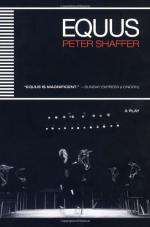
“Equus” is a 1974 Tony Award-winning play written by Peter Schaffer and published in 1973. It details the efforts of Dr. Martin Dysart to get to the root of the problems affecting neurotic seventeen year-old Alan Strang, who has blinded six horses with a pick at the stable where he works. Dysart is reluctant to take the case on, because he is overworked, but ultimately agrees to do so. Yet his experiences with Alan ultimately disturb him, and make him question the fundamentals of his own work.
Alan is obsessed with horses, to the point of worshipping them religiously. Alan’s father, an atheist, blames religion on his son’s problems, while his mother says that Alan is his own person, and is to blame himself. Dysart finds that Alan’s obsession with horses is rooted in a childhood experience with a horse, where he felt powerful and free by controlling a horse by riding one. This obsession skirts with the sexual as well, and after a failed sexual encounter with a girl in a stable, Alan attacks the horses, believing they can see all and know all.
Dysart realizes that Alan can be treated, and will be treated. But Dysart is jealous of the kind of passion that Alan has experienced, because he himself has never experienced anything remotely similar in modern society, which looks down on any kind of real passion. Dysart worries that, although he will cure Alan, he will make Alan a ghost.
Read more from the Study Guide
|
This section contains 249 words (approx. 1 page at 400 words per page) |
|




