
 Print
Print Word
Word PDF
PDF|
This section contains 252 words (approx. 1 page at 400 words per page) |

|
Eleanor Roosevelt, Volume One, 1884-1933 Summary & Study Guide Description
Eleanor Roosevelt, Volume One, 1884-1933 Summary & Study Guide includes comprehensive information and analysis to help you understand the book. This study guide contains the following sections:
This detailed literature summary also contains Bibliography and a Free Quiz on Eleanor Roosevelt, Volume One, 1884-1933 by Blanche Wiesen Cook.
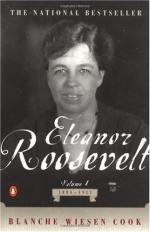
Blanche Wiesen Cook's Eleanor Roosevelt, Volume One, 1884-1933 is the first of a three-volume biography that reexamines the life and work of Eleanor Roosevelt. When published by Viking in 1992, it quickly became a bestseller. It was also controversial.
The biography is written from a feminist perspective, and it presents Roosevelt as a role model for women today. Cook explains that Roosevelt was unwilling to live her life within the strict limits imposed by a male-dominated society. As a woman of wealth and privilege, married to a rising politician, Roosevelt would normally have been expected to confine herself to managing the household, raising the children, perhaps engaging in some worthy charitable work, and supporting her husband's career. But Eleanor Roosevelt insisted on developing a more independent life. She forged a new identity for herself by engaging in meaningful political activity at a time when women had just received the right to vote. Cook sees Roosevelt as a committed progressive who championed an agenda of social reform and who attained genuine political power in her own right.
The controversial aspect of the biography mostly concerned Cook's argument that when Eleanor Roosevelt was married and in her forties, she had an affair with her bodyguard, Earl Miller, and also had an erotic relationship with a female reporter, Lorena Hickok. Previous biographers have been far more cautious in assessing both of these friendships. Cook argues her case persuasively from the available evidence, but not everyone has been convinced of the truth of her conclusions.
Read more from the Study Guide
|
This section contains 252 words (approx. 1 page at 400 words per page) |
|




