
 Print
Print Word
Word PDF
PDF|
This section contains 791 words (approx. 2 pages at 400 words per page) |

|
Dr. Jekyll and Mr. Hyde Summary & Study Guide Description
Dr. Jekyll and Mr. Hyde Summary & Study Guide includes comprehensive information and analysis to help you understand the book. This study guide contains the following sections:
This detailed literature summary also contains Quotes and a Free Quiz on Dr. Jekyll and Mr. Hyde by Robert Louis Stevenson.
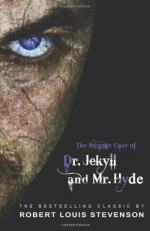
The Strange Case of Dr. Jekyll and Mr. Hyde is a classic story by Robert Louis Stevenson. In this story, Mr. Utterson, a lawyer and friend of Dr. Jekyll’s, is bothered by a will written by his friend that completely benefits a strange fellow named Mr. Hyde. To protect his friend, Mr. Utterson begins investigating Mr. Hyde, only to discover some truths about his friend that he could never have suspected. The Strange Case of Dr. Jekyll and Mr. Hyde is a mystery that brings into question the basic duality of the human personality.
Mr. Utterson is walking with his kinsman when they pass a door that Mr. Utterson has reason to question. Mr. Utterson asks his kinsman if he knows the man that lives in this home and is surprised to discover his kinsman not only has met this man, but he experienced a dark episode involving this same person. One day, the kinsman was walking on that same street when he witnessed the resident of that home run over a child while walking quickly over the sidewalk. The man began to leave when the kinsman and members of the child’s family stopped him. They finally convinced the man to pay the family compensation for his act. The man presented them with a check. However, they were unsure that they could trust him. So, he remained in their presence until the check was cashed.
Mr. Utterson returns home and reviews a will written by Dr. Jekyll, his good friend, that benefits this violent stranger, Mr. Hyde. Mr. Utterson is concerned about this will and speaks to Dr. Lanyon, who is a mutual friend of Dr. Jekyll and Mr. Utterson. Dr. Lanyon says he has never heard of Mr. Hyde, but that he and Dr. Jekyll have had a falling out over a difference in opinion. He has not seen him recently. A short time later, Mr. Utterson has occasion to meet Mr. Hyde and is not impressed with his rough, unfriendly attitude.
Mr. Utterson seeks out his friend, Dr. Jekyll, and they talk about the will. Dr. Jekyll tries to reassure Mr. Utterson that everything is okay. No one is trying to take advantage of him. However, Mr. Utterson continues to worry. When Mr. Utterson learns that Mr. Hyde has killed another client of Mr. Utterson’s for no apparent reason, he becomes doubly concerned. Afterward, Dr. Jekyll assures him that he no longer wants that will to be enforced and that his relationship with Mr. Hyde is done.
For a few months, Dr. Jekyll behaves more socially and more at ease. However, his behavior suddenly changes once more. He goes back to living an isolated life, hiding out in his rooms. Mr. Utterson goes to visit Dr. Lanyon and finds him dying. Dr. Lanyon leaves a letter to Mr. Utterson that is to be opened only upon Dr. Jekyll’s death or disappearance.
A short time later, Mr. Utterson is called to the home of Dr. Jekyll where he learns that his friend has been hiding in his laboratory for days on end, begging his servants to run errands for him to various chemists all over the city, but unsatisfied with the product they bring back. Mr. Utterson and Dr. Jekyll’s butler bust down the door to his laboratory and find Mr. Hyde dead on the floor of an apparent suicide. Afterward, Mr. Utterson and the butler find a letter to Mr. Utterson along with a large package also left to Mr. Utterson.
Mr. Utterson returns home and reads first Dr. Lanyon’s letter and then opens the package from Dr. Jekyll. It turns out that Dr. Jekyll has been curious about the duality of human nature and devised a way to separate the darkness of his own personality from the overall personality. This darkness came out of him in the form of Mr. Hyde. At first, Dr. Jekyll enjoyed the freedom of being Mr. Hyde from time to time, but he soon discovered that Mr. Hyde was pure evil, that he was always filled with anger and darkness. Therefore, Dr. Jekyll begins to think he should not drink the potion that turns him into Mr. Hyde any more. To his surprise, however, Dr. Jekyll finds himself transforming into Mr. Hyde without the use of the potion. It is a shocking and frustrating situation for Dr. Jekyll that he scrambles to try to fix, without success. One of the powders Dr. Jekyll originally used was tainted with something, but he cannot find a similar combination again; therefore, his potion no longer works. For this reason, Dr. Jekyll makes the decision to kill himself rather than allow Mr. Hyde loose on the world.
Read more from the Study Guide
|
This section contains 791 words (approx. 2 pages at 400 words per page) |
|




