
 Print
Print Word
Word PDF
PDF|
This section contains 244 words (approx. 1 page at 400 words per page) |

|
Driving Miss Daisy Summary & Study Guide Description
Driving Miss Daisy Summary & Study Guide includes comprehensive information and analysis to help you understand the book. This study guide contains the following sections:
This detailed literature summary also contains Bibliography and a Free Quiz on Driving Miss Daisy by Alfred Uhry.
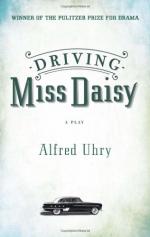
Alfred Uhry had already been writing for musical theater for twenty-five years when his first nonmu-sical play Driving Miss Daisy became a surprise smash hit. Originally slated to run for five weeks at a small theater in New York City, demand for tickets was so high that it moved to a larger theater where it ran for about three years. Uhry also won the Pulitzer Prize in 1988. In his preface to the published play, Uhry commented on the experience.
When I wrote this play I never dreamed I would be writing an introduction to it because I never thought it would get this far.... When I wonder how all this happened ... I can come up with only one answer. I wrote what I knew to be the truth and people have recognized it as such.
Indeed, the numerous critics who lauded the play displayed remarkable similarity in their comments. They liked the play's sincerity, dignity, and honesty. Dealing with issues that plague all people white or African American, northern or southern the appeal of Driving Miss Daisy is universal.
Driving Miss Daisy went on to become an equally successful movie, winning best picture, best actress, and best screenplay adaptation for Uhry. Uhry's surprise success has also given him the freedom to continue pursuing his writing. In plays and musicals since Driving Miss Daisy, Uhry has continued to explore issues of concern to southern Jews, but his work is essentially about basic humanity.
Read more from the Study Guide
|
This section contains 244 words (approx. 1 page at 400 words per page) |
|




