
 Print
Print Word
Word PDF
PDF|
This section contains 259 words (approx. 1 page at 400 words per page) |

|
Dream on Monkey Mountain Summary & Study Guide Description
Dream on Monkey Mountain Summary & Study Guide includes comprehensive information and analysis to help you understand the book. This study guide contains the following sections:
This detailed literature summary also contains Bibliography and a Free Quiz on Dream on Monkey Mountain by Derek Walcott.
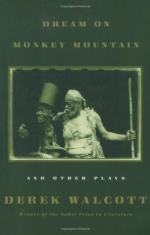
Though St. Lucia native Derek Walcott is primarily recognized as a Nobel Prize-winning poet, he has also written numerous plays for the Trinidad Theater Workshop, including Dream on Monkey Mountain. It is Walcott's best known and most performed play. Dream on Monkey Mountain was first performed on August 12, 1967, at the Central Library Theatre in Toronto, Canada. After at least one production in the United States, the play made its New York City debut on March 14, 1971, at St. Mark's Playhouse. This production garnered Walcott an Obie Award. Regularly performed since its inception, Dream on Monkey Mountain is a complex allegory which, at its heart, concerns racial identity. Makak, the central character of the play, lives alone on Monkey Mountain. He has not seen his own image in thirty years and ends up in jail after drunkenly destroying a café. Much of the play consists of his dream in which he discovers his selfworth as a black man. Critics are divided over many aspects of Dream on Monkey Mountain, including the effectiveness of its poetic language. Reviewing a 1970 production of the play in Los Angeles, W. I. Scobie of National Review wrote, "In Walcott's dense, poetic text and in the visual images onstage there is a brilliantly successful marriage of classical tradition and African mimetic-dance elements, two strains that are bound as one into the author's British colonial childhood. And in the myth of Makak, an ultimately universal figure, there is achieved some resolution of the conflict between black roots and white culture. This is a superb play."
Read more from the Study Guide
|
This section contains 259 words (approx. 1 page at 400 words per page) |
|




