
 Print
Print Word
Word PDF
PDF|
This section contains 505 words (approx. 2 pages at 400 words per page) |

|
Dracula Summary & Study Guide Description
Dracula Summary & Study Guide includes comprehensive information and analysis to help you understand the book. This study guide contains the following sections:
This detailed literature summary also contains Quotes and a Free Quiz on Dracula by Bram Stoker.
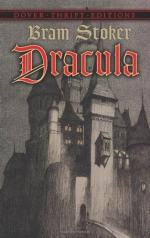
In the story Dracula, a young solicitor named Jonathan Harker travels to Transylvania to finalize paperwork with a client named Count Dracula. The paperwork is related to a house Dracula purchased in London. Jonathan disparages the superstitious peasants until he arrives at Dracula’s isolated, dark castle. He notices many strange things there, including Dracula’s non-reflective appearance, lack of appetite, and sharp teeth. Locals bring wooden boxes to the house, and Jonathan discovers them filled with dirt in a chapel. Dracula sleeps in one. Jonathan feels like a prisoner as the weeks drag on, and he fears Dracula and his harem of three wanton women will kill him. He keeps a detailed diary of all that transpires as he frets about Mina, his fiancé at home in Exeter.
Mina is worried about Jonathan as well when weeks pass without letters from him. She visits her childhood friend Lucy Westenra in a coastal village named Whitby. Lucy, though happily engaged to a man named Arthur Holmwood, seems restless. She takes to sleepwalking. Mina finds her one night in a churchyard with a strange dark being over her. A storm brings a mysterious ship to Whitby, with only a dead captain and many wooden boxes on board. Mina receives word from a hospital in Budapest that Jonathan is ill with brain fever. She immediately goes to him. They marry simply, and Jonathan, who cannot remember what happened in Transylvania, gives Mina his journal, asking her to keep it safe but not to read it.
Lucy goes to London with her mother, but her health is poor. Her fiancé Arthur asks his friend, Dr. John Seward, to examine her. Seward runs a lunatic asylum where he studies a particularly interesting patient named Renfield, a man who eats any live creatures that he can finds. Seward is also a rejected suitor of Lucy. He finds nothing physically or mentally wrong with her, beyond two strange puncture wounds on her neck. He sends for his Dutch friend Dr. Van Helsing to look at her. Van Helsing has a theory about Lucy’s illness, but he won’t share it.
Lucy’s health gets better and worse as she frequently and mysteriously loses blood overnight. Van Helsing uses some strange objects to treat her, including garlic and crucifixes. Despite constant transfusions from Arthur, the two doctors, and another former suitor named Quincey Morris, Lucy dies. When a newspaper story reveals that a woman has abducted children nearby and the children return home with neck wounds, Van Helsing finally asks Seward to open his mind to the idea that Lucy is a vampire. Seward is doubtful until he sees Lucy’s lifelike body in her tomb. Van Helsing enlists Arthur and Quincey to witness Lucy out of her tomb during the night. Then, they give her eternal peace by staking her through the heart and cutting off her head. Van Helsing asks the men to join him in the quest to kill Dracula, Lucy’s demon maker.
Read more from the Study Guide
|
This section contains 505 words (approx. 2 pages at 400 words per page) |
|




