
 Print
Print Word
Word PDF
PDF|
This section contains 247 words (approx. 1 page at 400 words per page) |

|
The Double Helix Summary & Study Guide Description
The Double Helix Summary & Study Guide includes comprehensive information and analysis to help you understand the book. This study guide contains the following sections:
This detailed literature summary also contains Bibliography and a Free Quiz on The Double Helix by James D. Watson.
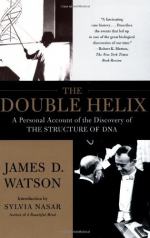
Accounts of scientific discovery often go unread by the general public, falling only into the hands of members of the scientific community and students preparing for the field. When James D. Watson published The Double Helix in 1968, however, many readers from the general population were attracted to the bookfor two reasons: it was not laden with so much scientific detail that it was incomprehensible, and, perhaps most appealing, it was controversial. Watson's story is more a personal memoir than a recording of data. While unraveling the structure of deoxyribonucleic acid (DNA) is one of the most remarkable discoveries in history, Watson's telling of how it was discovered is just as astounding in the world of scientific publishing.
What makes this book so unusual is the author's honesty in describing the actions and personalities of his colleagues and in admitting his own role in the ' 'shady" side of research. Sneak peeks at other scientists' data, withheld information, alcohol, attraction to women, heated arguments, and the joy of watching a competitor make a public blunder all play as large a role in The Double Helix as X-ray crystallography, genetics, and molecular structure. Although Harvard University Press had agreed to publish Watson's book, it reneged on that agreement when prepublication galleys caused an uproar among "offended" members of the scientific community. Picked up by Atheneum Press, this account of the discovery of the "secret of life" is one of science's most provocative, unorthodox, and fun publications.
Read more from the Study Guide
|
This section contains 247 words (approx. 1 page at 400 words per page) |
|




