
 Print
Print Word
Word PDF
PDF|
This section contains 312 words (approx. 1 page at 400 words per page) |

|
Democracy Summary & Study Guide Description
Democracy Summary & Study Guide includes comprehensive information and analysis to help you understand the book. This study guide contains the following sections:
This detailed literature summary also contains Bibliography and a Free Quiz on Democracy by Joan Didion.
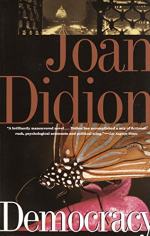
Democracy, Joan Didion's fourth novel, published in 1984, takes a sardonic look at the relationship between politics and personal life. The tension between the public and private persona of the novel's main character, Inez Victor, is examined in the context of a life led in the glare of mass media. As the wife of an ambitious congressman, senator, and aspirant to the Presidency, Inez has been groomed in playing to the public. She is not at all comfortable in this role.
The novel is at its most biting when Inez and Billy Dillon, her husband's political adviser and public relations operator, are goading one another. Although she appreciates Dillon's ironic abrasiveness rather more than her husband's woolly political jargon, Inez resents, for example, interviewers deciding in advance the angle of their profile on the basis of library cuttings. It is as if she has lost all personal claim to her past. Her own memory, and hence her history, have been fictionalized. The main events of the novel occur in 1975, the year of the United States's withdrawal from Vietnam. It is therefore impossible to read the story of Inez's marriage, and her affair with the elusive Jack Lovett, as pure personal drama.
Democracy, as the title implies, is also the story of the way in which a nation has lost touch with its own past and with the principles that once guided it. Many of those who commented on the novel when it was first publication greeted it as Didion's best novel to date. It was seen as a book that combined the barbed observational precision of her journalism with the broader scope of the novelist. Others were put off by the tentative nature of its composition, and in particular by the intrusive voice of the narrator, who regularly informs the reader of directions previous versions of the book might have taken.
Read more from the Study Guide
|
This section contains 312 words (approx. 1 page at 400 words per page) |
|




