
 Print
Print Word
Word PDF
PDF|
This section contains 216 words (approx. 1 page at 400 words per page) |

|
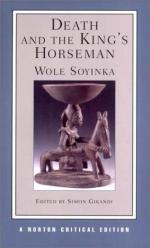
Death and the King's Horsemen Summary & Study Guide Description
Death and the King's Horsemen Summary & Study Guide includes comprehensive information and analysis to help you understand the book. This study guide contains the following sections:
This detailed literature summary also contains Quotes and a Free Quiz on Death and the King's Horsemen by Wole Soyinka.
Wole Soyinka’s play, “Death and the King’s Horseman, is based on actual events occurring in British-occupied Nigeria. The play focuses around the duty of Elesin, the King’s Horseman, to commit suicide in the wake of the King’s death the month before. It is the duty of British Colonial District Officer Simon Pilkings to stop him. Cheered and egged on by his friends and fellow Yoruba tribesmen and women, Elesin knows it is his duty to die, so that he can guide the King in the afterlife. Pilkings and the British consider the act barbaric and illegal They consider all life sacred, so they aim to stop him.
Elesin’s last day on Earth is enjoyable, as he marries a young girl for his last earthly pleasure. But, his will to die weakens because of this, and he does not want to die. Pilking’s entry gives Elesin a way out. Elesin is arrested, and he blames his misfortunes on everyone, but ultimately comes to accept responsibility that he has shirked his own duty. In order to save the honor of the household and the tribe, Elesin’s son Olunde commits suicide in his father’s place. Stricken with shame and grief, Elesin commits suicide using his prison chains.
Read more from the Study Guide
|
This section contains 216 words (approx. 1 page at 400 words per page) |
|




