
 Print
Print Word
Word PDF
PDF|
This section contains 289 words (approx. 1 page at 400 words per page) |

|
Darkness at Noon Summary & Study Guide Description
Darkness at Noon Summary & Study Guide includes comprehensive information and analysis to help you understand the book. This study guide contains the following sections:
This detailed literature summary also contains Quotes and a Free Quiz on Darkness at Noon by Arthur Koestler.
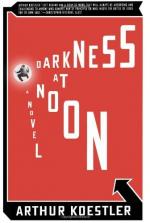
Darkness at Noon, by Arthur Koestler, is a political novel that tells the story of Rubashov, a Russian political prisoner. Rubashov is arrested in the middle of the night for a myriad of reasons, not the least of which is a reported plot to assassinate a political leader.
At the interrogation a week later, Rubashov is surprised that his interrogator is a friend named Ivanov with whom he had served during the Civil War. Rubashov and Ivanov have an almost pleasant conversation before Ivanov asks Rubashov to confess. Ivanov tells Rubashov he could save his life by confessing, but Rubashov refuses.
Several weeks go by. Rubashov begins talking with his neighboring prisoners by a series of knocks on the cell walls. After some time, Rubashov is allowed to go for walks in the yard. During these walks, Rubashov meets a fellow prisoner. The man has been in solitary confinement for more than twenty years, a fact that has caused him to become somewhat insane.
Rubashov is unaware that there have been some discussions about the way in which Ivanov has handled Rubashov’s case. Gletkin, a fellow warden, thinks that Ivanov should be harsher with Rubashov. Before Rubashov’s second interrogation, Gletkin has a fellow prisoner executed, walking him out of the cell block in front of Rubashov. This causes Rubashov to become angry with Ivanov when he comes the following day.
Rubashov decides to confess and sends a letter to Ivanov. However, Ivanov has been arrested and executed. Gletkin takes over Rubashov’s interrogation. Rubashov is forced to stay awake for days at a time and is given very little food. Eventually, Rubashov confesses. At the trial, Rubashov is convicted and sentenced to death.
Read more from the Study Guide
|
This section contains 289 words (approx. 1 page at 400 words per page) |
|




