
Forgot your password?  
Related Topics

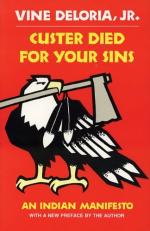
Custer Died for Your Sins: An Indian Manifesto Quiz

This Study Guide consists of approximately 43 pages of chapter summaries, quotes, character analysis, themes, and more - everything you need to sharpen your knowledge of Custer Died for Your Sins.

Custer Died for Your Sins: An Indian Manifesto Quiz

Students: Take our free Custer Died for Your Sins: An Indian Manifesto quiz below, with 25 multiple choice questions that help you test your knowledge. Determine which chapters, themes and styles you already know and what you need to study for your upcoming essay, midterm, or final exam. Take the free quiz now!

Teachers: The BookRags Lesson Plan contains hundreds of test and quiz questions, including multiple choice, short answer, and essay questions. Create your own quiz or test with our automatic test generator, or choose from our ready-to-go chapter quizzes, midterm tests, and final exams. Don’t waste time reinventing the wheel, get the Lesson Plan today!

Directions: Click on the correct answer.

1)

Which group of Indians did Arthur Watkins target first in his work for the government? (from Part 3)

The Cheyenne.
Indians east of the Mississippi.
Southwest Indians.
Indians in his home state of Utah.
2)

At this time of this writing, how does a man hold his chairmanship? (from Part 9)

By visiting reservations.
By producing results.
By giving moving speeches.
By attending meetings of importance.
3)

What kind of hats to anthropologists wear? (from Part 4)

Australian bush hats.
Baseball caps.
Straw hats.
Indian warbonnets.
4)

What provision did Watkins attach to the bill for the Menominee distribution of judgment money? (from Part 3)

A provision for mineral rights.
A provision for water rights.
A provision for hunting rights.
A provision of termination.
5)

What did one anthropologist admit spending while studying a tribe of less than a 1,000 people? (from Part 4)

Two hundred dollars.
One hundred and forty thousand dollars.
A million dollars.
Two thousand dollars.
6)

What favorite hymn surprised old warriors in church? (from Part 5)

Closer my God to Thee.
Onward Christian Soldiers.
By the River.
My God is an Awesome God.
7)

In battle, who did Indians have little respect for? (from Part 9)

Soldiers who used guns.
All soldiers.
Officers.
A white general who did not lead his men into battle.
8)

Indians have come to rely on strong leaders and created what in turn? (from Part 9)

The President complex.
The hatred for Congress.
The War Chief complex.
Indian Unity.
9)

Among the Sioux in the Dakotas, what was the Sun Dance reinterpreted as? (from Part 5)

Christmas service.
Palm Sunday service.
Tenebre service.
The annual convocation of the missions on each reservation.
10)

What does an anthropologist come to the reservation to do? (from Part 4)

Write down everything they see.
Help the Indians with a building project.
Make observations.
Enjoy the food.
11)

When the buffalo were gone, what did the Sioux eat to keep from starving? (from Part 7)

Deer.
Skunks.
Cats.
Dogs.
12)

Who is Frank Takes Gun? (from Part 5)

The leader of the Native American Church.
The author of this book.
The chairman of the Bureau of Indian Affairs.
A gun-control lobbyist.
13)

What is the main problem for the Plains Indians? (from Part 4)

They still want to go to war.
An inadequate land base that continues to shrink because of land sales.
They have no water.
They spend all day making eagle warbonnets.
14)

What, according to many Indians, is the culture of the white man? (from Part 8)

Continual exploitation.
Violence with the Indians.
War with Indians.
Continual exploration.
15)

When Watkins visited the Menominee, what did he compare the living conditions to? (from Part 3)

Pearl Harbor after the Japanese attack.
War torn Italy.
Hiroshima after the atomic bomb.
The refugee camps of the Near East after World War II.
16)

In 1964, what percentage of Indians thought the United States should get out of Vietnam? (from Part 7)

15 percent.
80 percent.
10 percent.
85 percent.
17)

Who did Clyde Warrior support in the 1964 Presidential Campaign? (from Part 8)

Goldwater.
Nixon.
Kennedy.
Johnson.
18)

What is the reputation of the Bureau of Indian Affairs office in Juneau? (from Part 6)

It is run by white men.
It is representative of the people it serves.
It has the best reputation for service to native peoples of any of the area offices.
It holds fast to fishing rights.
19)

Of all the great Indian leaders, who maintained his influence in his tribe until his death? (from Part 9)

Geronimo.
Red Cloud.
Sitting Bull.
Chief Joseph.
20)

What is the best way to start a heated argument during an Indian meeting? (from Part 9)

Speak on the need for new leadership.
Speak on the need for unity.
Talk about water rights.
Talk about land use.
21)

Once a church was assigned to a reservation, what happened to the other churches? (from Part 5)

Other churches could invite Indians to worship on their reservation.
Other churches could talk to members of the reservation to try to gain access.
They could also build a church on the same reservation.
They were prohibited from entering a reservation.
22)

What does the author believe the Indians should have a right to, just like water districts, cities, and towns? (from Part 6)

Sovereignty.
Social services.
Voting rights.
Citizenship.
23)

Who are the Five Civilized Tribes? (from Part 5)

Cherokee, Choctaw, Creek, Seminole and Zuni.
Seneca, Choctaw, Creek, Zuni and Cherokee.
Cherokee, Choctaw, Creek, Seminole and Chickasaw.
Cherokee, Apache, Zuni, Seminole and Chickasaw.
24)

In 1964, what percentage of Indian thought the United States should get out of America? (from Part 7)

10 percent.
15 percent.
85 percent.
90 percent.
25)

What was the decision about the Pottawatomie of Kansas during the time of termination? (from Part 3)

Better to have them expire as private citizens than let anyone know how badly they had been treated.
To move them to Missouri.
To get them better hospitals and roads.
To combine them with tribes in Oklahoma.
Copyrights
Custer Died for Your Sins: An Indian Manifesto from BookRags and Gale's For Students Series. ©2005-2006 Thomson Gale, a part of the Thomson Corporation. All rights reserved.
Follow Us on Facebook
