
 Print
Print Word
Word PDF
PDF|
This section contains 434 words (approx. 2 pages at 400 words per page) |

|
Call It Sleep Summary & Study Guide Description
Call It Sleep Summary & Study Guide includes comprehensive information and analysis to help you understand the book. This study guide contains the following sections:
This detailed literature summary also contains Bibliography and a Free Quiz on Call It Sleep by Henry Roth.
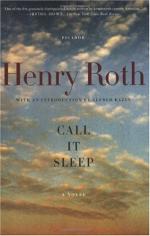
Henry Roth's 1934 novel Call It Sleep is based loosely on the author's own experiences growing up as a Jewish American in New York City during the early 1900s. In the novel, David Schearl is a young boy who must come to terms with conflicting forces in an effort to forge his own identity. The conflicting forces include intense love for and dependence on his mother Genya coupled with fear and hatred for his unstable father Albert. David must also reconcile his Jewish heritage with both his mainstream American tendencies and his curiosity about other cultures and religions.
The novel is notable for its use of Yiddish both directly and indirectly through character dialogue. Most of the dialogue spoken in the Schearl household is in Yiddish, but it is transcribed for the reader in deliberately formal and elegant phrasing. By contrast, the language David and his friends use in the streets is rough, profane, and so heavily seasoned with dialect that it can be difficult to understand. For example, "W'od id 'ey do t'yuh in de polliss station?" is what one character asks after David returns from a brief episode at a local police station. This turns the table on the reader, clearly illustrating the struggles immigrants face when trying to communicate in a language that is not natively their own. The author does this by transforming Yiddish into easily understood English, and transforming English into a daunting collection of strange sounds.
Call It Sleep was first published in the middle of the Great Depression, and it was consequently overlooked by many mainstream readers at the time. Although Roth still wrote occasional short stories after the novel's poor performance, he relied on alternate careers to support himself for the next thirty years. It was only in the 1960s, when the novel was rediscovered by critics and readers alike, that Roth was finally able to once again return to writing as more than just a hobby.
Call It Sleep offers a view of the American dream through the eyes of an immigrant child. In addition, the book has earned its place as an enduring document of the Jewish American experience. As Alfred Kazin writes in his introduction to the Picador paperback edition of the novel,
Though the book was not properly welcomed or understood until it was reissued in paperback in 1964, it has become a world favorite, with millions of copies in print. We can see now that the book belongs to the side of the 1930s that still believed in the sacredness of literature, whether or not it presumed to change the world.
Read more from the Study Guide
|
This section contains 434 words (approx. 2 pages at 400 words per page) |
|




