
 Print
Print Word
Word PDF
PDF|
This section contains 459 words (approx. 2 pages at 400 words per page) |

|
The Birthday Party Summary & Study Guide Description
The Birthday Party Summary & Study Guide includes comprehensive information and analysis to help you understand the book. This study guide contains the following sections:
This detailed literature summary also contains Bibliography and a Free Quiz on The Birthday Party by Harold Pinter.
Harold Pinter's The Birthday Party, was the playwright's first commercially-produced, full-length play. He began writing the work after acting in a theatrical tour, during which, in Eastbourne, England, he had lived in "filthy insane digs." There he became acquainted with "a great bulging scrag of a woman" and a man who stayed in the seedy place. The flophouse became the model for the rundown boarding house of the play and the woman and her tenant the models, respectively, for the characters of Meg Boles and Stanley Webber.
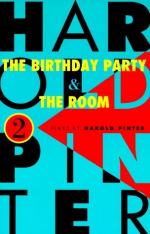
In an earlier work, The Room, a one-act play, Pinter had worked on themes and motifs that he would carry over into The Birthday Party and some of his succeeding plays. Among these themes are the failure of language to serve as an adequate tool of communication, the use of place as a sanctum that is violated by menacing intruders, and the surrealistic confusions that obscure or distort fact.
Directed by Pinter himself, the finished full-length play premiered in Cambridge, England, at the Arts Theatre, on April 28, 1958. There and on tour in Oxford it was quite successful, but when, under the direction of Peter Wood, it moved to London and later opened, on May 19, at the Lyric Opera House in Hammersmith, it met with harsh reviews and closed down within a week. Among the reviewers, only Harold Hobson of the Sunday Times saw much promise in the play. He thought that Pinter had considerable originality and was "the most disturbing and arresting talent in theatrical London." However, his review appeared too late to do the production any good. The show was already off the boards, done in by abysmal attendance, including one matinee audience of six, and persistently hostile reviews. Most critics opined that Pinter floundered in obscurity and suffered from the negative influence of Samuel Beckett (Waiting for Godot), Eugene Ionesco (The Bald Prima Donna), and other avant-garde writers.
Pinter would later marvel at the fact that in London the play was "completely massacred by the critics" but noted that it was the only maltreatment he had received from reviewers and that it never dimmed his interest in writing. The work, in fact, became the dramatist's first full-length "comedy of menace," a group of plays that secured Pinter's reputation as a premier, avant-garde playwright. Subsequent productions were much better received, including the play's 1964 revival at London's Aldwych Theatre and its 1968 Broadway premier at the Booth Theatre in New York. By the mid-1960s, the burgeoning appreciation of absurdist drama and the success of other plays by Pinter, including The Dumbwaiter (1959) and The Caretaker (1960), had secured for The Birthday Party a reputation as a classic in the dramatic genre that literary critic Martin Esslin dubbed the Theatre of the Absurd.
Read more from the Study Guide
|
This section contains 459 words (approx. 2 pages at 400 words per page) |
|




