
Forgot your password?  
Related Topics

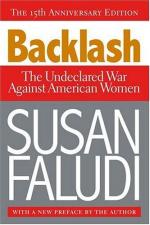
Backlash: The Undeclared War against American Women | Quiz

This Study Guide consists of approximately 153 pages of chapter summaries, quotes, character analysis, themes, and more - everything you need to sharpen your knowledge of Backlash.

Backlash: The Undeclared War against American Women | Quiz

Students: Take our free Backlash: The Undeclared War against American Women quiz below, with 25 multiple choice questions that help you test your knowledge. Determine which chapters, themes and styles you already know and what you need to study for your upcoming essay, midterm, or final exam. Take the free quiz now!

Teachers: The BookRags Lesson Plan contains hundreds of test and quiz questions, including multiple choice, short answer, and essay questions. Create your own quiz or test with our automatic test generator, or choose from our ready-to-go chapter quizzes, midterm tests, and final exams. Don’t waste time reinventing the wheel, get the Lesson Plan today!

Directions: Click on the correct answer.

1)

When making an indictment of 1980s films featuring female jobs, Faludi states that these movies do all of the following except: (from Part 2: Chapters 5-6)

Showing why women are better off staying home.
Fail to indict a demoralizing marketplace.
Show female jobs as tedious and supportive of male enterprises.
Show women as recognizing the sacrifices of being working women, but highly satisfied with their choices.
2)

To deal with the backlash message while maintaining their identities, many women heed the "little voice" inside that calls for ________. (from Epilogue)

Marriage and family.
Self-expression.
Service to a greater cause.
Self-destruction.
3)

Which of the following magazines uses the Harvard-Yale study to sell minis? (from Part 2: Chapters 7-8)

Mademoiselle.
Women's Day.
Newsweek.
Women's Wear Daily.
4)

Which of the following two anti-feminist movies are made into television sitcoms? (from Part 2: Chapters 5-6)

Private Benjamin and Fatal Attraction.
Baby Boom and Private Benjamin.
No answers are correct.
Fatal Attraction and Baby Boom.
5)

According to Faludi, cosmetic companies try to increase sales by ___________ their products. (from Part 2: Chapters 7-8)

Cleaning up.
Reducing.
Medicalizing.
Augmenting.
6)

Beverly LaHaye founds Concerned Women for America (CWA); her husband Tim LaHaye is co-founder of which organization? (from Part 3: Chapters 9-10)

Free Congress Foundation.
Moral Majority.
Heritage Foundation.
Young Americans for Freedom.
7)

In the epilogue, Faludi states that Riggs and other women know which of the following? (from Epilogue)

It will be a difficult fight from the bottom.
All answers are correct.
They have made no inroads with men.
There is nowhere to go but forward.
8)

Faludi suggests that women change the minds of individual men when they do which of the following? (from Epilogue)

Use their feminine abilities to garner support from unsuspecting men.
Recognize that they are the superior gender and work from that premise.
Work together vocally and unapologetically.
Play both sides of the issue with slightly stronger women supporting the feminist perspective.
9)

Which of the following women is a Harvard-educated lawyer and author of nine books who twice runs for Congress? (from Part 3: Chapters 9-10)

Connaught ("Connie") Marshner.
Beverly LaHaye.
Faith Whittlesey.
Phyllis Schlafly.
10)

Faludi writes that all of the following designers try to push femininity onto working women except: (from Part 2: Chapters 7-8)

Christian Dior.
Christian Lacroix.
John Weitz.
Calvin Klein.
11)

Which of the following claims to be the "media's number one psychologist," broadcasting live, nationwide, from Los Angeles? (from Part 4: Chapter 12)

Karen Horney.
Teresa Bernardez.
Robin Norwood.
Toni Grant.
12)

In the 1980s, Faludi makes the point that women are marginalized and can ask for childcare and parental leave only if they forego seeking all of the following except: (from Part 3: Chapters 9-10)

Health care.
Equal pay.
Educational opportunity.
Reproductive freedom.
13)

In 1988, Robert Filoso defines the "New Generation" of female beauty with mannequins that are: (from Part 2: Chapters 7-8)

Taller, more slender, and poutier.
Flawless, shorter, bustier, and wasp-waisted.
All answers are correct.
Flawless, slender, and shorter.
14)

Which of the following companies chooses to fight the EEOC's case brought against it? (from Part 4: Chapter 13)

Sears Roebuck & Co.
General Motors.
AT&T.
General Electric.
15)

Television assaults the women's movement less than Hollywood movies; Faludi states that this is because of what factor? (from Part 2: Chapters 5-6)

Hollywood movies have greater budgets and more freedom with their creativity.
Television producers do not wish to tackle these issues through on-screen programming.
There are more women executives in the television industry who support the women's movement.
Women are a majority of viewers and are advertisers' prime target.
16)

If I'm So Wonderful, Why Am I Still Single? (1988) was written by which of the following authors? (from Part 4: Chapter 12)

Susan Page.
Robin Norwood.
Toni Grant.
Susan Price.
17)

NBC and ABC use which of the following to undercut women's efforts to organize? (from Part 4: Chapter 13)

Layoffs.
All answers are correct.
Promotion of corporate faithfuls only.
Threats and harassment.
18)

Sylvia Ann Hewlett worked at which university? (from Part 3: Chapter 11)

No answers are correct.
Cornell.
Barnard College.
Yeshiva University.
19)

Faludi claims that the requirement of parental consent results in which of the following statistics? (from Part 4: Chapter 14)

A forty percent climb in the birth rate among fifteen to seventeen-year-olds.
All answers are correct.
A reversal in the eighteen-year trend of a downward teenage birthrate.
A two percent rise in second trimester abortions.
20)

According to Faludi, at the end of the 1980s women go back to___________ about ___________. (from Epilogue)

Not caring, offending men.
Worrying, offending men.
Worrying, maintaining the status quo.
Not caring, maintaining the status quo.
21)

In the 1980 presidential election, the only clear differentiation from the Democrats comes when the Republicans do what according to Faludi? (from Part 3: Chapters 9-10)

All answers are correct.
Revoke the Equal Pay Act
Put forth an anti-abortion platform.
Oppose the ERA.
22)

Which researcher finds no statistically significant difference in how the sexes reason morally in nineteen Kohlberg studies? (from Part 3: Chapter 11)

Lawrence Walker.
Carol Gilligan.
Susan Brownmiller.
Zella Luria.
23)

According to Faludi what is the greatest fear of suffrage opponents in the 1910s? (from Part 3: Chapters 9-10)

Political indifference by women.
Smaller household sizes among the middle class.
The creation of a "feminist party."
The decline of morality in society.
24)

According to Faludi, rather than helping women to overcome the problems with misogyny, the book If I'm So Wonderful, Why Am I Still Single? suggests that women can be happy only if they do all of the following EXCEPT: (from Part 4: Chapter 12)

Learn to compromise.
Stop trying to make men change.
Strive to be self-fulfilled.
Postpone careers until children are grown.
25)

The chapter "Teen Angels and Unwed Witches" turns to which of the following media? (from Part 2: Chapters 5-6)

Television.
Newspaper.
Movies.
Magazines.
Copyrights
Backlash: The Undeclared War against American Women from BookRags and Gale's For Students Series. ©2005-2006 Thomson Gale, a part of the Thomson Corporation. All rights reserved.
Follow Us on Facebook
Homework Help
