
 Print
Print Word
Word PDF
PDF|
This section contains 347 words (approx. 1 page at 400 words per page) |

|
All Quiet on the Western Front Summary & Study Guide Description
All Quiet on the Western Front Summary & Study Guide includes comprehensive information and analysis to help you understand the book. This study guide contains the following sections:
This detailed literature summary also contains Topics for Discussion on All Quiet on the Western Front by Erich Maria Remarque.
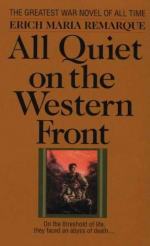
All Quiet on the Western Front tells the story of Paul Baumer, a nineteen-year-old school graduate who, along with his entire class, enlists in the military to fight for Germany in World War I. Paul is both the narrator and the main character, and the book begins when Paul’s unit –Second Company –is at rest a few miles behind the front lines.
Paul tells a little about his friends and the group of soldiers he socializes with and introduces the reader to the crudity and odd humor of military life. Paul also writes about how they all joined up because of the glorious talk about war and country from their old schoolmaster. But war, they all discover, is not glorious. Second Company has lost nearly half its strength on the front lines, and reinforcements have been brought up. From rest, the refitted Second Company returns to battle on the Western Front.
There, they deal with constant bombardments and French infantry assaults. Battles and events blur together. Paul is given leave, and he returns home for fourteen days to visit his family. But his mother is sick, and Paul feels isolated from the peace and quiet of his home. He wants desperately to return to that place of peace before the war, but he knows he has changed, and he can never fully do so after experiencing everything that has transpired since his war experience.
He reflects how his generation has been defined by the war and is unnecessary in the grand scheme of things. The older generation of soldiers will return to lives, careers, and families when the war ends. The next generation will not care about war. Paul’s generation has been totally consumed by military conflict.
He returns to the front, is wounded, given medical leave, and returns to the front lines. One by one, his friends are killed off until Paul is the sole surviving member of his social circle and of his graduating class. On a day of relative peace along the entire Western Front, Paul is killed.
Read more from the Study Guide
|
This section contains 347 words (approx. 1 page at 400 words per page) |
|




