
 Print
Print Word
Word PDF
PDF|
This section contains 541 words (approx. 2 pages at 400 words per page) |

|
Chapters 1-4 Summary and Analysis
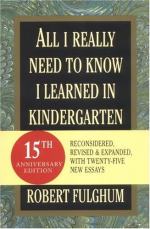
Starting in Fulghum's youth, every spring, the author sits down and writes out a list of personal beliefs. The first list was quite long because the author wanted to make sure every base was covered in the written statement. Over the years, the list has become shorter; first, it was idealist; today, it may be cynical, comical, or boring. One day Fulghum put high octane gas into an old car, which couldn't handle the high octane and bucked the whole way home. Fulghum realized that the credo was much like the gas; if there is too much to process, it will be no good to anyone. From that day forward, the credo became, in essence, everything he had learned in kindergarten. Examples of these rules include playing fair, sharing, cleaning up after yourself, and taking naps every afternoon. Fulghum...
(read more from the Chapters 1-4 Summary)
|
This section contains 541 words (approx. 2 pages at 400 words per page) |
|





