
 Print
Print Word
Word PDF
PDF|
This section contains 297 words (approx. 1 page at 400 words per page) |

|
In An Inquiry into the Nature and Causes of the Wealth of Nations (1776), economist Adam Smith (whom Galbraith describes as "one of the founding trinity of economics") puts forth the first systematized theory of political economy.
In his Essay on Population (1798), Thomas Robert Malthus (whom Galbraith describes as "one of the founding trinity of economics") offers his theory of the relationship between population growth and economic stability.
In Principles of Political Economy and Taxation (1817), David Ricardo (who is also described by Galbraith as "one of the founding trinity of economics") outlines his highly influential theories of trade and taxation.
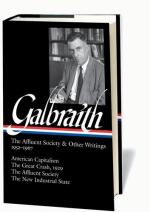
In American Capitalism: The Concept of Countervailing Power (1951), Galbraith argues against the over-valuation of competition in industry structure.
In The Great Crash (1955), Galbraith provides an explanation of the economic conditions of the stock market crash of 1929, which led to the Great...
|
This section contains 297 words (approx. 1 page at 400 words per page) |
|





