 Print
Print Word
Word PDF
PDF|
This section contains 822 words (approx. 3 pages at 300 words per page) |

|
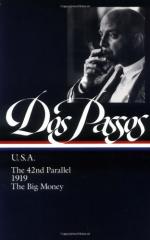
Dos Passos once said that the novelist is "the architect of history." In U.S.A. he developed one of the most radical yet utilitarian designs for a novel created during an era of great technical experimentation. The U.S.A.
trilogy, made up of The 42nd Parallel (1930), Nineteen Nineteen (1932), and The Big Money (1936), blends four distinct types of narration into a unique vehicle for expression and cultural commentary.Some critics have called his experiment a "documentary" novel, and Dos Passos was influenced by the documentary techniques of the Russian film director Sergi Eisenstein. But to label U.S.A. a documentary novel is to ignore the fictional narrative that is, after all, its central interest. It is more accurate to consider these books as experiments in a "multi-textured novel," a form that allows the author a wide range of narrative modes from the...
|
This section contains 822 words (approx. 3 pages at 300 words per page) |
|