Forgot your password?  

Not What You Meant?  There are 44 definitions for Wilson.  Also try: Woody or Woodrow.

Wilson, Woodrow | Research & Encyclopedia Articles

Print-Friendly   Order the PDF version   Order the RTF version
About 3 pages (963 words)
Woodrow Wilson Summary


Wilson, Woodrow

(b. December 28, 1856; d. February 3, 1924) Twenty-eighth president of the United States (1913–1921); presidency marked by substantial use of military, president during World War I; enunciated Fourteen Points as American war aims and helped forge the Treaty of Versailles/League of Nations, but the treaty was rejected by Senate.

Woodrow Wilson was born in Staunton, Virginia, the son of a Presbyterian minister, and graduated from Princeton University in 1879. With a doctorate from the Johns Hopkins University, he taught history and political science at Bryn Mawr, Wesleyan, and Princeton. He became president of Princeton in 1902. A Democrat, Wilson was elected governor of New Jersey in 1910 and president of the United States in 1912, being reelected in 1916.

Although Wilson came to the presidency emphasizing a progressive domestic agenda and instituted many reforms in office, his presidency was marked by substantial use of military force, including the massive U.S. intervention in World War I. Wilson believed that the use of force was sometimes necessary to achieve foreign policy goals, although as a liberal internationalist, he preferred diplomacy, moral suasion, and international law to promote democracy, commerce, and peaceful relations among nations. Wilson justified his use of the armed forces on such idealistic grounds.

He used the military most frequently in Latin America. In April 1914, U.S. forces temporarily occupied the Mexican port of Vera Cruz. In July 1915, they occupied Haiti and in May 1916, the Dominican Republic. In summer 1916, Wilson dispatched a punitive expedition deep into northern Mexico when revolutionaries raided across the U.S. border.

At the outbreak of the European War in 1914, Wilson declared neutrality, but by 1916, the vastly expanded American trade with the Allies and German submarine warfare threatened to draw the United States into the war. When a U-boat sank the British liner Lusitania in May 1915 with the loss of 1,198 lives, including 128 Americans, Wilson had responded with personal diplomacy that by 1916 led to suspension of U-boat warfare. In the 1916 election year, under cross pressures regarding the need to increase the U.S. armed forces, Wilson endorsed a compromise expansion of the U.S. Army and National Guard, including the creation of a Reserve Officer Training Corps (ROTC), and supported a major building program for the navy.

Still, the president sought to avoid being drawn into the European war. In May 1916, he praised the idea of a postwar league to enforce peace. After his reelection in

Woodrow Wilson (right) with British Prime Minister Lloyd George (left) and French Prime Minister Georges Clemenceau (center) at a peace conference in Paris, 1919. GETTY IMAGESWoodrow Wilson (right) with British Prime Minister Lloyd George (left) and French Prime Minister Georges Clemenceau (center) at a peace conference in Paris, 1919. GETTY IMAGES

November 1916, he sought to mediate an end to the war. This failed, and in January 1917, he announced his own vision of a peace without vengeance and territorial gains, a "Peace without Victory."

When the Germans, in a desperate gamble, instituted unrestricted submarine warfare in February 1917, Wilson, recognizing the sharp divisions among Americans, considered armed neutrality but ultimately chose full belligerency. His war message in April emphasized German violations of neutral rights and his desire to end autocracy and encourage democracy. He also wanted to shape a liberal, internationalist peace based on postwar cooperation and collective security.

During the war, Wilson proved a forceful wartime commander in chief. He pressured a reluctant Democratic Congress to adopt the modern selective draft, which became the model for raising the majority of America's soldiers in most of the nation's wars in the twentieth century. To mobilize the economy and public opinion, Wilson created a host of powerful ad hoc agencies that were later replicated in World War II. However, extensive wartime violations of civil liberties at all levels left a dark legacy and, in reaction, resulted in the postwar founding of the American Civil Liberties Union (ACLU).

Militarily, Wilson gave Gen. John J. Pershing, commander of the American Expeditionary Forces, maximum freedom in maintaining and directing an American army in France. But in October 1918, when a desperate German government asked Wilson for an armistice based on his liberal "Fourteen Points" peace plan of January 1918, the president forced Pershing and the Allied military leaders to abandon plans for an invasion of Germany and accept an armistice and the Fourteen Points as the basis for negotiations.

In 1919, Wilson became the first serving U.S. President to go to Europe. At the Paris peace talks, he conceded a number of the Fourteen Points to obtain his larger aim—participation in The League of Nations. But when he submitted the Treaty of Versailles to a Republican controlled Senate in July 1919, it failed, a victim of partisan politics, fears of loss of American sovereignty, discontentment with concessions, and the intransigence of a president handicapped by a massive stroke in October 1919.

The United States did not join the League of Nations, and a period of renewed unilateralism ensued. But the Wilsonian vision of collective security linked to liberal ideals would reemerge as a dominant aspect of U.S. policy during World War II and the second half of the twentieth century.

Conscription, World War I; Economy, World War I; Financing, World War I.

Bibliography

Chambers II, John Whiteclay. The Tyranny of Change: America in the Progressive Era, 1890–1920, 2d ed., updated. New Brunswick, NJ: Rutgers University Press, 2000.

Clements, Kendrick A. The Presidency of Woodrow Wilson. Lawrence: University Press of Kansas, 1992.

James, D. Clayton and Wells, Anne Sharp. America and the Great War, 1914–1920. Wheeling, IL: Harlan Davidson, 1998.

Knock, Thomas J. To End All Wars: Woodrow Wilson and the Quest for a New World Order. New York: Oxford University Press, 1992.

Link, Arthur S.; and Chambers, John Whiteclay, II. "Woodrow Wilson as Commander in Chief." In The United States Military under the Constitution of the United States, 1789–1989, edited by Richard H. Kohn, (pp. 317–375). New York: New York University Press, 1991.

Thompson, John A. Woodrow Wilson. London: Longman, 2002.

This is the complete article, containing 963 words (approx. 3 pages at 300 words per page).

More Information
  • View Wilson, Woodrow Study Pack
  • 44 Alternative Definitions
  • Search Results for "Wilson, Woodrow"
  • More Products on This Subject
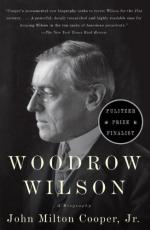
    Thomas Woodrow Wilson
    Thomas Woodrow Wilson (1856-1924), twenty-eighth president of the United States, led the country in... more

    Woodrow Wilson
    Woodrow Wilson, the historian and political scientist, will always be eclipsed by Wilson, the presi... more


    Ask any question on Woodrow Wilson and get it answered FAST!
    Answer questions in BookRags Q&A and earn points toward
    discounted or even FREE Study Guides and other BookRags products!
    Learn more about BookRags Q&A
    Copyrights
    Wilson, Woodrow from Americans at War. Copyright © 2001-2006 by Macmillan Reference USA, an imprint of the Gale Group. All rights reserved.