Forgot your password?  

Not What You Meant?  There are 132 definitions for Wave.

Waves | Research & Encyclopedia Articles

Print-Friendly   Order the PDF version   Order the RTF version
About 5 pages (1,350 words)
Wave Summary


Waves

A wave is a disturbance that travels either through a medium (mechanical waves, such as sound waves) or through space (electromagnetic waves, such as light waves). As a wave travels, it carries energy from one place to another. Waves are used to describe phenomena such as sound, light, and the behavior of particles.

Some waves require a medium in order to propagate. This means that certain waves must actually have physical contact between particles in order to transfer kinetic energy, the energy of motion. These waves are called mechanical waves. In a mechanical wave, a disturbance causes a portion of the medium to deviate from an equilibrium (resting) position. Because it is physically connected to a nearby portion, it causes the nearby portion to deviate from its equilibrium position, but because the influence is by means of a force, the new portion accelerates rather than moves instantaneously. The mass of the new portion governs how fast it reacts to the force. Thus the influence propagates, not at an infinite speed, but at a speed related to the strength of the connecting force and inversely related to the massiveness of the moving particles. Dimensional analysis then can be used to show that the speed of propagation of a material wave is the square root of a force-like term and a mass-like term.

Some waves do not require a medium. Physical contact between particles is not necessary for the kinetic energy to be transferred. They can be transmitted through a vacuum. These waves disturb electric and magnetic fields instead of particles. This type of wave is called an electromagnetic wave. An example of a mechanical wave is a sound wave. Electromagnetic waves include light, microwaves, and radio waves.

Waves also can include the wave-like behavior of particles such as electrons and photons in a phenomenon called wave-particle duality. Scientists use this duality to describe the idea that particles can act like waves, and waves can act like particles. Wave-particle duality explains Albert Einstein's photoelectric effect; that electrons emitted from a metal exposed to high frequency light exhibited the properties of frequency and wavelength. The wave-particle duality has given rise to equations, called wave functions, which are used to describe the structure of the atom and the behavior of subatomic particles. The study of wave functions and how they describe atoms is called quantum mechanics.

Sound is produced when an object vibrates, causing a transfer of kinetic energy through a medium. This transfer of kinetic energy causes a series of compressions (areas where the surrounding molecules are crowded together) and rarefactions (areas where the molecules are spread out). These compressions and rarefactions move through the medium, away from the original vibration. When a series of compressions and rarefactions move through a medium, they create a wave disturbance where the movement of the material's particles from equilibrium is parallel to the direction of propagation. These waves are called longitudinal waves. Sound waves in air are longitudinal waves.

Transverse waves oscillate up and down or from side to side. The direction of a transverse wave that travels through a medium is perpendicular to the motion of the medium. The waves that travel on a guitar string when it is plucked are transverse waves.

Other transverse waves oscillate transversely, but do not require a medium. For example, light is energy emitted by electrons in atoms. This energy travels in a wave with both electric and magnetic behavior. Light, therefore, is called an electromagnetic wave. Other electromagnetic waves include infrared waves, ultraviolet waves, and x rays. Electromagnetic waves travel through space at the speed of light. These waves are the result of combined electric and magnetic fields. Changing an electric field will produce a magnetic field, and changing a magnetic field will produce an electric field. These electric and magnetic fields move through space, combining to produce electromagnetic waves. The electric and magnetic fields move at right angles to each other.

Some waves are neither transverse nor longitudinal, but rather a combination of the two. One such wave is a surface wave. Surface waves occur at the boundary, or surface, of two different mediums. An example of a surface wave would be ocean waves, those occurring at the surface between the ocean water and the air. The water molecules in the ocean do not simply move up and down or back and forth, instead, they move in a circular motion. This circular motion is a combination of transverse and longitudinal wave motion.

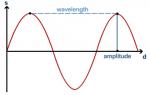
All waves, with the exception of impulsive waves, share certain characteristics. These characteristics are amplitude, wavelength, and frequency. Impulsive waves do not have a wavelength or a frequency. Any wave also exhibits a phenomenon known as Fourier decomposition. When a wave passes through a medium, the particles of the medium vibrate and are moved from their original position. The amplitude of a wave is the height of a wave crest, or the highest point of a wave. This is the farthest distance a particle moves from its original position. The wavelength is the distance between two successive crests. Wavelength is symbolized by the Greek letter .

The frequency of a wave is the number of crests that pass a given point per second. Frequency is measured as waves (or cycles) per second, or hertz (Hz). One hertz is equal to one cycle per second.

The speed of a wave can be described by both its frequency and its wavelength and can be calculated using the equation: speed = frequency x wavelength. The speed of a wave is measured in meters per second when frequency is measured in hertz and wavelength is measured in meters. The speed of a wave is constant in any particular medium. Therefore, if the frequency is increased, the wavelength decreases, and visa versa, as illustrated in the above equation.

The speed of a wave in a particular medium depends on the elasticity and density of the medium through which the waves travel. Waves travel faster in solids and slower in gases. The molecules in a solid bounce back faster when vibrated than liquids or gases. The particles in a solid are packed more tightly together than a liquid or a gas. As a result, when one particle of a solid is displaced, it displaces its neighboring particles with a greater acceleration, resulting in a faster wave. The molecules in a gas are much more spread out than in a liquid or a solid. The propagation of a wave in a gas requires the collision of two molecules. As a result, the speed of a wave in a gas is slower than in a liquid or a solid.

Waves can interact with their medium and boundaries in four different ways; through reflection, refraction, diffraction, and interference. Reflection occurs when a wave bounces back from a barrier or the end of a medium through which it is traveling. Refraction occurs when a wave travels through one medium into another. Refraction is a result of a change in velocity of a wave as it passes through different media. Diffraction occurs when waves bend around a barrier in their path. Diffraction explains why we can hear someone's voice when they are around the corner, in a different room. Christiaan Huygens, a Dutch scientist, developed a principle to explain diffraction. According to Huygen, the crest of any wave can act as a series of wave sources, equally spaced. As a wave is broken by a barrier, the broken crest can act like a new wave source, prodicing new waves. Waves can combine with other waves to produce interference. The interference may have an additive effect, called constructive interference, or a deleterious effect, called destructive interference. Waves in a linear medium can superimpose. When two or more waves are present at the same point in a medium at the same time, a new wave forms that is a sum of the individual waves.

The study of waves and their properties have provided valuable information for many branches of science. Waves explain the behavior of electrons, light, sound, atoms, and even earthquakes. Physicists, chemists, and physicians have used the study of waves and wave behavior for both theoretical and practical purposes.

This is the complete article, containing 1,350 words (approx. 5 pages at 300 words per page).

More Information
  • View Waves Study Pack
  • 132 Alternative Definitions
  • Search Results for "Waves"
  • More Products on This Subject
    Wave Motions
    With regard to Earth science, wave motion describes the physical transmission of force or energy po... more

    Wave Motion
    A wave is nothing more than a disturbance that moves from place to place in some medium, carrying e... more


    Ask any question on Wave and get it answered FAST!
    Answer questions in BookRags Q&A and earn points toward
    discounted or even FREE Study Guides and other BookRags products!
    Learn more about BookRags Q&A
    Copyrights
    Waves from World of Physics. ©2005-2006 Thomson Gale, a part of the Thomson Corporation. All rights reserved.

    Join BookRagslearn moreJoin BookRags

    Join BookRagslearn moreJoin BookRags