Forgot your password?  

Not What You Meant?  There are 120 definitions for The War of the Worlds.  Also try: Wow.

War of the Worlds | Research & Encyclopedia Articles

Print-Friendly   Order the PDF version   Order the RTF version
H. G. Wells
About 4 pages (1,242 words)
The War of the Worlds Summary


War of the Worlds

Broadcast on October 30, 1938, Orson Welles' Mercury Theatre radio dramatization of H.G. Wells' War of the Worlds engendered a mass panic in which millions of Americans believed they were being invaded by Martians; in so doing, the broadcast dramatically demonstrated the nascent power of mass media in American culture.

The Mercury Theatre group, headed by the 23-year-old Welles, had built a small national audience with its weekly radio adaptations of literary classics such as Joseph Conrad's Heart of Darkness. Welles, his partner John Houseman, and writer Howard Koch collaborated on the hour-long scripts. The trio nearly scrapped their War of the Worlds adaptation, as Koch's faithful approximation of the novel did not translate well in rehearsals. The group decided to stick with the project after re-working the script to mirror a news broadcast. Nevertheless, as group members and even Welles himself later recalled, the feeling in the studio on the day of the broadcast was that War of the Worlds would not be a successful production.

The show commenced at 8 p.m. that Halloween eve, following an introduction by a CBS announcer which presented Wells' novel as the subject of the forthcoming dramatization. In the first 10 minutes of the broadcast, Welles masterfully built dramatic tension by juxtaposing fireside chat-styled meditations on renewed American prosperity with increasingly frequent news bulletins on atmospheric disturbances detected by astronomers across the United States. Just as thousands of listeners switched over from the more popular Charlie McCarthy show (a less-than-compelling singer had just been introduced), Welles' group delivered a frantic news report from the small town of Grovers Mill, New Jersey, where Martians had landed and wiped out an entire United States military force: "A humped shape is rising out of the pit. I can make out a small beam of light against a mirror. What's that? There's a jet of flame springing from that mirror, and it leaps right at the advancing men. It strikes them head on! Good Lord! They're turning into flame!" As the broadcast followed the progress of the Martians up the East Coast, the reports became even more dire. "People are falling like flies," Welles reported. "No more defense. Our army wiped out … artillery, air force, everything wiped out. This may be the last broadcast." An actor portraying the Secretary of the Interior informed listeners that President Franklin Delano Roosevelt had declared a national emergency.

As the dramatization continued, thousands of Americans panicked. In New York City, hundreds of people jammed railroad and bus stations to escape the menace. In Birmingham, Alabama, sorority women at a local college lined up at campus telephones to speak to parents and loved ones for the last time. In Pittsburgh, a man found his wife in the bathroom, clutching a poison bottle and yelling "I'd rather die this way than that." And, in a favorite story of Welles', actor John Barrymore, upon hearing the broadcast, drunkenly took to his backyard, where he unleashed his Great Danes from their doghouse with the admonition: "Fend for yourselves!" It has been estimated that 12 percent of the radio audience heard the broadcast and more than half that number took it seriously; by sociologist Hadley Cantril's account, which was published in a landmark contemporary study sponsored by the Rockefeller foundation, more than a million people were frightened by Welles' broadcast. Cantril's demographic survey placed the strongest currents of fear among less-educated people and poor Southern folk.

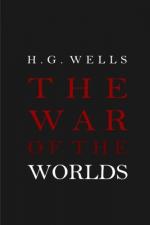
Cover of The War of the Worlds by H.G. Wells. Cover of The War of the Worlds by H.G. Wells.

Welles concluded his broadcast with a re-statement of the fictionality of the presentation ("The Mercury Theatre's own radio version of dressing up in a sheet and saying 'Boo!"' as Welles put it), but the hysteria continued well into the night. CBS was inundated with calls; newspaper switchboards were jammed, and mobs continued to crowd the streets of New York and northern New Jersey. When the truth became apparent, public hysteria turned into ire directed at CBS. Hundreds threatened lawsuits against the network, not the least of which was from H.G. Wells himself; the Federal Communications Commission promised a full-fledged inquiry, and the New York City police, for a time, even contemplated arresting Welles. As calmer heads prevailed, the public furor died down, and Welles became an overnight sensation; many of his biographers claim that without the celebrity engendered by the War of the Worlds broadcast, Welles might never have been able to bring his craft to Hollywood, where he became a celebrated director with films such as Citizen Kane (1941) and The Magnificent Ambersons (1942).

The War of the Worlds episode highlighted the emerging power of mass media over the American public. It demonstrated the power of the media to form and shape opinion in American culture, and also the passive willingness on the part of the public to place its faith in the legitimacy of sound and image. Ironically, War of the Worlds represented one of radio's final assertions of power within the media sphere; by the 1950s, television had replaced radio as the dominant force in mass culture.

Scholars assert that Welles' broadcast was so widely believed because it struck a particular chord with Americans in the years before World War II. The show aired just after the Munich crisis, to which Welles alluded at the outset of the broadcast, and the recent international conflict may have influenced some to believe that the reported invasion was not extraterrestrial at all. Sociologists have also located the show's resonance in the latent anxiety of the general population, engendered by years of economic depression. "On the surface, the broadcast was implausible and contradictory, but that didn't matter," asserts Joel Cooper. "In that one instance, people had an immediate explanation for all the unease and disquiet they had been feeling. And suddenly, they could do something. They could gather their families. They could run."

War of the Worlds remained a vibrant part of American popular culture in the second half of the twentieth century. In 1953, Byron Haskin produced a Hollywood film about the broadcast and, from 1988-1990, a television series inspired by Welles' take on War of the Worlds enjoyed a successful run. In 1988, the fiftieth anniversary of the broadcast, public radio stations across America aired an ambitious remake of War of the Worlds starring Jason Robards and featuring the Oscar-winning sound effects of Randy Thom; the citizens of Grovers Mill commemorated their town's role in the historic broadcast with a four-day festival that culminated with the unveiling of a bronze statue of Welles at a microphone and a rapt family gathered around its radio.

Up until his death in 1985, Welles would never reveal whether he had anticipated the massive misinterpretation of his radio drama. Whether intended as a hoax or not, however, the landmark War of the Worlds broadcast demonstrated the American public's preference for reading media's sound—and later its images—as truth rather than fiction.

Further Reading:

Baughman, James. The Republic of Mass Culture: Journalism, Filmmaking, and Broadcasting in America Since 1941. Baltimore and London, Johns Hopkins University Press, 1992.

Brown, Robert J. Manipulating the Ether: The Power of Broadcast Radio in Thirties America. Jefferson, McFarland & Co., 1998.

Cantril, Hadley. The Invasion from Mars: A Study in the Psychology of Panic with the Complete Script of the Famous Orson Welles Broadcast. Princeton, Princeton University Press, 1940.

Higham, Charles. Orson Welles: The Rise and Fall of an American Genius. New York, St. Martin's Press, 1985.

Thomson, David. Rosebud: The Story of Orson Welles. New York, Alfred A. Knopf, 1996.

This is the complete article, containing 1,242 words (approx. 4 pages at 300 words per page).

More Information
  • View War of the Worlds Study Pack
  • 120 Alternative Definitions
  • Search Results for "War of the Worlds"
  • More Products on This Subject
    Comparisons
    The tendency and actions of the people, the appearance, alacrity, and the belief of the aliens, the ... more


    Ask any question on The War of the Worlds and get it answered FAST!
    Answer questions in BookRags Q&A and earn points toward
    discounted or even FREE Study Guides and other BookRags products!
    Learn more about BookRags Q&A
    Copyrights
    War of the Worlds from St. James Encyclopedia of Popular Culture. ©2005-2006 Thomson Gale, a part of the Thomson Corporation. All rights reserved.