
 Print
Print Word
Word PDF
PDF|
This section contains 5,246 words (approx. 18 pages at 300 words per page) |

|
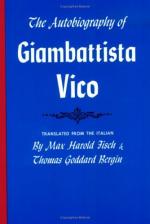
Born in Naples, Italy, in 1668, Giambattista Vico is best known for his critique of the Cartesian method and his philosophy of history. Beyond these areas, he is also known for contributions to linguistic theory, legal history, and cultural anthropology. Many have construed Vico as an eighteenth-century thinker who expressed the germ of ideas more fully developed in the nineteenth century. Thus, for example, Karl Löwith understands Vico's master work The New Science to anticipate "not only fundamental ideas of Herder and Hegel, Dilthey and Spengler, but also the more particular discoveries of Roman history by Niebuhr and Mommsen, the theory of Homer by Wolf, the interpretation of mythology by Bachofen, the reconstruction of ancient life through etymology by Grimm, the historical understanding of laws by Savigny, of the ancient city and of feudalism by Fustel de Coulanges, and of the class struggles by...
|
This section contains 5,246 words (approx. 18 pages at 300 words per page) |
|



