Forgot your password?  

Not What You Meant?  There are 113 definitions for Velocity.  Also try: VF or Delta-v.

Velocity and Acceleration Vectors | Research & Encyclopedia Articles

Print-Friendly   Order the PDF version   Order the RTF version
About 2 pages (689 words)
Velocity Summary


Velocity and Acceleration Vectors

Mathematically a vector in the plane is just an ordered pair of real numbers. Physicists tend to embellish this rather spare definition so that their vectors are represented by arrows with direction and magnitude indicating the direction and strength of forces, velocities, and accelerations among other things. Consider a point moving in the xy coordinate plane so that it traces out some curve as the path of its motion. As the point moves along this curve, the x and y coordinates are changing as functions of time. Suppose that x=f(t) and y=g(t). Now the mathematician will say that the position at any time t is (f(t),g(t)) and will say that the position vector for the point is R(t)=(f(t),g(t)). The physicist will say that the position vector R(t) is an arrow starting at the origin and ending with the tip of the arrow at the point (f(t),g(t)). It is now possible to define the velocity and acceleration vectors for this motion in terms of ideas from calculus. In calculus, the derivative of a function is defined to be the instantaneous rate of change of this function with respect to some variable. So, for example, the derivative of f(t) with respect to t (time), denoted by f(t) is the instantaneous rate of change of f with respect to time, also called the (instantaneous) velocity of f when f represents position. The term "instantaneous" refers to the fact that this velocity is not an average velocity over a given time interval, but a velocity computed at one instant of time. In fact, the instantaneous velocity at time t is the limiting value of average velocities of the form (f(t+h)-f(t))/h over time intervals of the form [t,t+h] as h approaches 0. This is an instance of the derivative of a function. Returning to our curve with position vector R(t)=(f(t),g(t)), it is reasonable to define an instantaneous velocity vector as the derivative of the position vector R(t).

Again, we regard this as the limiting value of average velocities of the form (R(t+h)-R(t))/h as h approaches 0. Since R(t)=(f(t),g(t)), it follows that (R(t+h)-R(t))/h=((f(t+h)-f(t))/h,(g(t+h)-g(t))/h) and as h approaches 0 we have R(t)=(f(t),g(t)) and this is the velocity vector of the point moving along the curve at time t. Now the physicists' arrow for the velocity vector is placed with its tail (the non-pointed end) at the point on the curve and lies along the tangent line to the curve at the point (f(t),g(t)). This physically symbolizes the fact that point is moving in the direction of its velocity vector at any time t. Since acceleration is the rate of change of velocity, the acceleration vector is the derivative of the velocity vector or the second derivative of the position vector. This is denoted by R'(t)=(f'(t),g'(t)). The physicists' arrow for acceleration is also drawn from the point (f(t),g(t)) and points in the direction of the concave side of the curve. An interesting special case is when the point is moving on a circle. In this case, the position vector arrow points outward from the center of the circle along a radius with the tip of the arrow ending at the point on the circle. If the circle has radius r and is centered at the origin, then R(t)=(rcos(t),rsin(t)). Using derivative rules for the cosine and sine functions proved in calculus, the velocity vector will be R(t)=(-rsin(t),rcos(t)). It can be shown that this vector's arrow is perpendicular to the position vector's arrow at the point (rcos(t),rsin(t)). Again using calculus, the acceleration vector R'(t)=(-rcos(t),-rsin(t))=-R(t), so that the acceleration vector's arrow points back toward the center of the circle. This is a model of spinning a ball attached to a string in a circular motion above one's head. The ball "wants" to fly off in a straight line in the direction of the velocity vector, but is being pulled back towards the center by it's acceleration resulting in a circular motion.

The account given above can be extended to three dimensional space with the following modifications. The position vector will have the form R(t)=(f(t),g(t),h(t)); the velocity vector will then be R(t)=(f(t),g(t),h(t)); and the acceleration vector will be R'(t)=(f'(t),g'(t),h'(t)).

This is the complete article, containing 689 words (approx. 2 pages at 300 words per page).

More Information
  • View Velocity and Acceleration Vectors Study Pack
  • 113 Alternative Definitions
  • Search Results for "Velocity and Acceleration Vectors"
  • More Products on This Subject
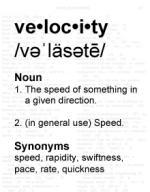
    Velocity
    The term velocity is often confused with speed; to understand the concept of velocity, it is helpfu... more

    Differentiating Distance and Velocity
    The kinematic quantities of distance and velocity are some of the most basic concepts in introducto... more


    Ask any question on Velocity and get it answered FAST!
    Answer questions in BookRags Q&A and earn points toward
    discounted or even FREE Study Guides and other BookRags products!
    Learn more about BookRags Q&A
    Copyrights
    Velocity and Acceleration Vectors from World of Mathematics. ©2005-2006 Thomson Gale, a part of the Thomson Corporation. All rights reserved.

    Join BookRagslearn moreJoin BookRags

    Join BookRagslearn moreJoin BookRags