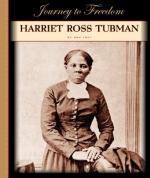
Tubman, Harriet
(b. ca. 1820; d. March 10, 1913) Former slave and conductor on the Underground Railroad, Civil War nurse and spy.
Harriet Tubman, heroine of the Underground Railroad, personally escorted as many as seventy or eighty former slaves to freedom in the North after her own daring flight from slavery in 1849. Frederick Douglass, whose Rochester, New York, home served as an Underground Railroad station, wrote to her in 1868, "Excepting John Brown—of sacred memory—I know of no one who has willingly encountered more perils and hardships to serve our enslaved people than you have" (Bradford, 1869). During the Civil War, she again risked her life in the antislavery cause by joining the Union Army in coastal South Carolina and Florida as a spy, scout, and nurse. Less well known but equally heroic was her postwar work, managing a small subsistence farm to support a large extended family in Auburn, New York. In her later years, she created a facility for the impoverished elderly in Auburn and found both private and church funding for it.
In 1844, while still a slave in Maryland, Harriet Tubman married John Tubman, a free black man. She had no children of her own, which was an advantage when she began to think of escape to the North, in 1849. When her legal owner, Edward Brodess, died, it seemed likely that she would be sold South and she decided to flee. She may have been helped initially by neighbors with anti-slavery sympathies—a white woman took her in and provided information leading to her next hiding place.
Tubman escaped alone to Philadelphia, where, aided by a strong abolitionist community, she found work and began to plan a return South for her family. John Tubman had remarried in 1851 and refused to join her. This personal blow may have intensified her belief that she had a mission to rescue her remaining kinfolk from slavery.
Harriet Tubman.
After the passage of the Fugitive Slave Act (1850), the Northern states were no longer safe havens for fugitive slaves and Tubman extended her route to Canada, guiding parties of up to ten or eleven to Saint Catharines, where a growing community of African Canadians welcomed newcomers to freedom.
Stories of the daring rescues by the "colored heroine" began to appear in the letters of her admiring abolitionist associate Thomas Garrett, a Quaker based in Wilmington, Delaware, who helped provide transportation, lodging, and funds for several thousand fugitives over his long Underground Railroad career.
In 1858 she met the antislavery crusader John Brown, then fresh from bloody guerrilla fighting against proslavery forces in the territory of Kansas. Knowing her skills, courage, and connections in the African-Canadian community, Brown sought her aid in recruiting former slaves as fighters for his forthcoming military action against slavery. She did not participate directly in the assault on the federal arsenal at Harpers Ferry, Virginia, in 1859 that led to Brown's death and martyrdom.
When the Civil War broke out, Tubman, along with other abolitionists, was disappointed in President Lincoln's failure to commit the Union to an explicitly anti-slavery policy. Nevertheless, in early 1862 she responded with enthusiasm when recruited by antislavery friends in Massachusetts to join the Union Army encampment in the federally occupied South Carolina Sea Islands. Although her assignment was ostensibly to perform humanitarian service work among the former slaves, she also served as a Union Army spy behind Confederate lines.
In South Carolina, Tubman recruited a small band of African-American men as spies and scouts, providing vital intelligence about Confederate capabilities and plans. She played a central role in the Combahee River Raid of June 1863, helping to destroy massive amounts of Confederate property and supplies.
Tubman's Civil War service also included the less glamorous but equally vital work of nursing. She nursed the wounded survivors of the 1863 assault on Fort Wagner by an African-American regiment from Massachusetts led by the abolitionist Robert Gould Shaw, who died in the battle. She also nursed Union troops in Florida who were suffering from dysentery, using a traditional root-based remedy.
Tubman was proud of her Civil War service, but because of her informal status (she was never officially enlisted) and gender she never received back pay, recognition as a veteran, or a veteran's pension, despite the repeated efforts of influential friends after the war, including Secretary of State William Seward. As an elderly woman, she was finally awarded a pension, but only as the widow of a veteran—her second husband.
At the war's end, Tubman returned to Auburn, New York, where she lived until her death. Immediately after the war, she raised funds for schools for the newly emancipated African Americans. Her major concern over the next fifteen years, however, was her own economic self-sufficiency and maintaining the home she shared with her elderly parents and an extended family of relatives and boarders. In her later years, she developed a new mission: raising funds for a home for the impoverished elderly. The Harriet Tubman Home opened under the auspices of the AME Zion church in 1908.
Rediscovered in the early twentieth century after many years of obscurity and poverty, Tubman again became an important symbol of heroic African-American womanhood. In the later twentieth century, the home evolved into a national shrine to Tubman's memory. She serves as an important symbol of slaves' intense desire for freedom and the bravery of those like her who risked their lives to achieve that freedom.
Abolitionists; Douglass, Frederick.
Bibliography
Bradford, Sarah. Scenes in the Life of Harriet Tubman. Auburn, NY: W. J. Moses, 1869.
Cheney, Ednah. "Moses." Freedmen's Record 1 (March 1965): 34–38.
Conrad, Earl. General Harriet Tubman. Washington, DC: Associated Publishers, 1943.
Humez, Jean M. Harriet Tubman: The Life and the Life Stories. Madison: University of Wisconsin Press, 2003.
Larson, Kate Clifford. Bound for the Promised Land: Harriet Tubman, Portrait of An American Hero. New York: Ballantine, 2003.
Sanborn, Franklin B. "Harriet Tubman." (Boston) Commonwealth, July 17, 1863.
This is the complete article, containing 971 words
(approx. 3 pages at 300 words per page).