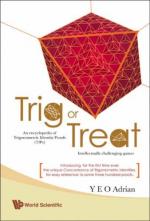
Trigonometric identities are equations that describe relationships between the various trigonometric functions. The trigonometric functions are a set of functions that are employed in the study of angles and angular relationships in planar and 3-dimensional figures. Development of the trigonometric identities was simultaneous with the development of the functions themselves. Claudius Ptolemy, one of the most influential Greek astronomers, was developing the identities in terms of chords of a circle or arcs as early as about 130. He showed that he knew one of the most important identities, sin (x + y) = sin x cos y + cos x sin y although instead of writing it in terms of sin and cos he used chords as they did in those times, very early in his career while studying astronomy.
The trigonometric identities are derived by expressing the sine or cosine of a sum of difference of angles in terms of the sines and cosines of the individual angles. The identities are true whenever they are meaningful, which distinguishes them from equations which are true only for particular values of x. Since all of the trigonometric functions can be defined in terms of sin and cos, the identities are often written involving these functions.
The most important trigonometric identity is sin2x + cos2x = 1. This identity has a name of its own and is called the Pythagorean identity. It is derived from the Pythagorean theorem and has been extended to the other trigonometric functions by dividing the original equation by cos2x and sin2x respectively to yield: tan2x + 1 = sec2x and 1 + cot2x = csc2x.
The next most important trigonometric identities involve the sum or difference of two different angles. The two most important of these identities are: sin (x + y) = sin x cos y + cos x sin y which was known by Ptolemy but in terms of chords and cos (x + y) = cos x cos y - sin x sin y. The other two related trigonometric identities are: sin (x - y) = sin x cos y - cos x sin y, and cos (x - y) = cos x cos y + sin x sin y. From these sets of relations it is possible to derive the identities for sin (2x) and cos (2x) which are left to the reader.
The last two most important trigonometric identities that allow one to derive all of the other identities are: sin (-x) = -sin x and cos (-x) = cos x. Using all of these identities it is possible to derive all of the other relationships between the trigonometric functions.
This is the complete article, containing 443 words
(approx. 1 page at 300 words per page).